
Pelikan M800
There's an affinity among fountain pen enthusiasts for the Pelikan M800. For years it has topped Shumi-no-bungubako's list as the #1 pen chosen by its readers. Pen-info's Tsuchihashi Tadashi, a pillar of the stationery community, also made a video professing his fondness for the M800.
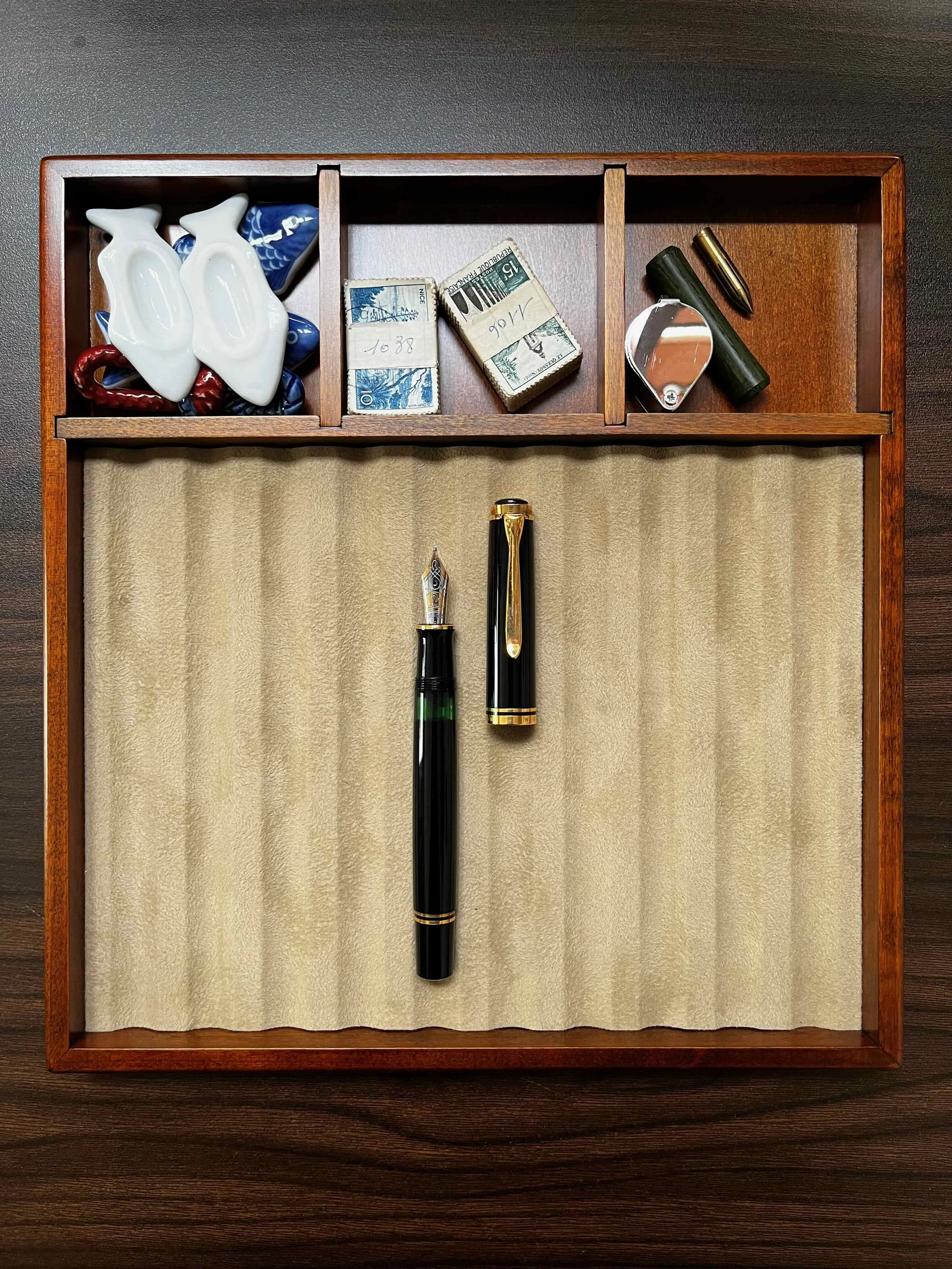
I previously discussed an urban legend involving the M800 and how it led to the creation of the Pilot Custom 823. Today's article will focus on the M800 itself.
Since its introduction in 1987, the M800 has undergone multiple evolutions. It was Pelikan's flagship until the larger M1000 took that title. The M800 initially only came in Pelikan's iconic green/black stripe and all-black. Throughout the years, a brown tortoiseshell, blue stripe, and red stripe have come and gone. Components have changed too. Brass medallions were present on both ends of the pen until Pelikan removed them in 1997. Both 14C and 18C nibs have been used. Joshua Danley's M800 compendium is an excellent article for those who wish to read more about this evolution.
Dating the production year of my M800
Because the M800 has seen multiple iterations, it's only fair that I narrow down which version I have. Unfortunately, it's not as easy as specifying the year in which this M800 was purchased. It is common for fountain pens to sit on the shelves of retailers for many years before they come into the possession of their first owner.
The most obvious clue can be found on the cap ring, which reads: 'PELIKAN W.-GERMANY'. The Berlin wall fell in 1989, but East and West Germany did not unite formally until 1990. Considering its introduction in 1987, this 'W.-GERMANY' engraving should put it somewhere between 1987-1990. Changing dies, however, requires time. Having worked in manufacturing myself, I highly doubt that Pelikan immediately scrapped its remaining cap rings and replaced them on the day the unification was made official. I wouldn't be surprised if retailers still received Pelikans with 'W.-GERMANY' engravings up until 1991.
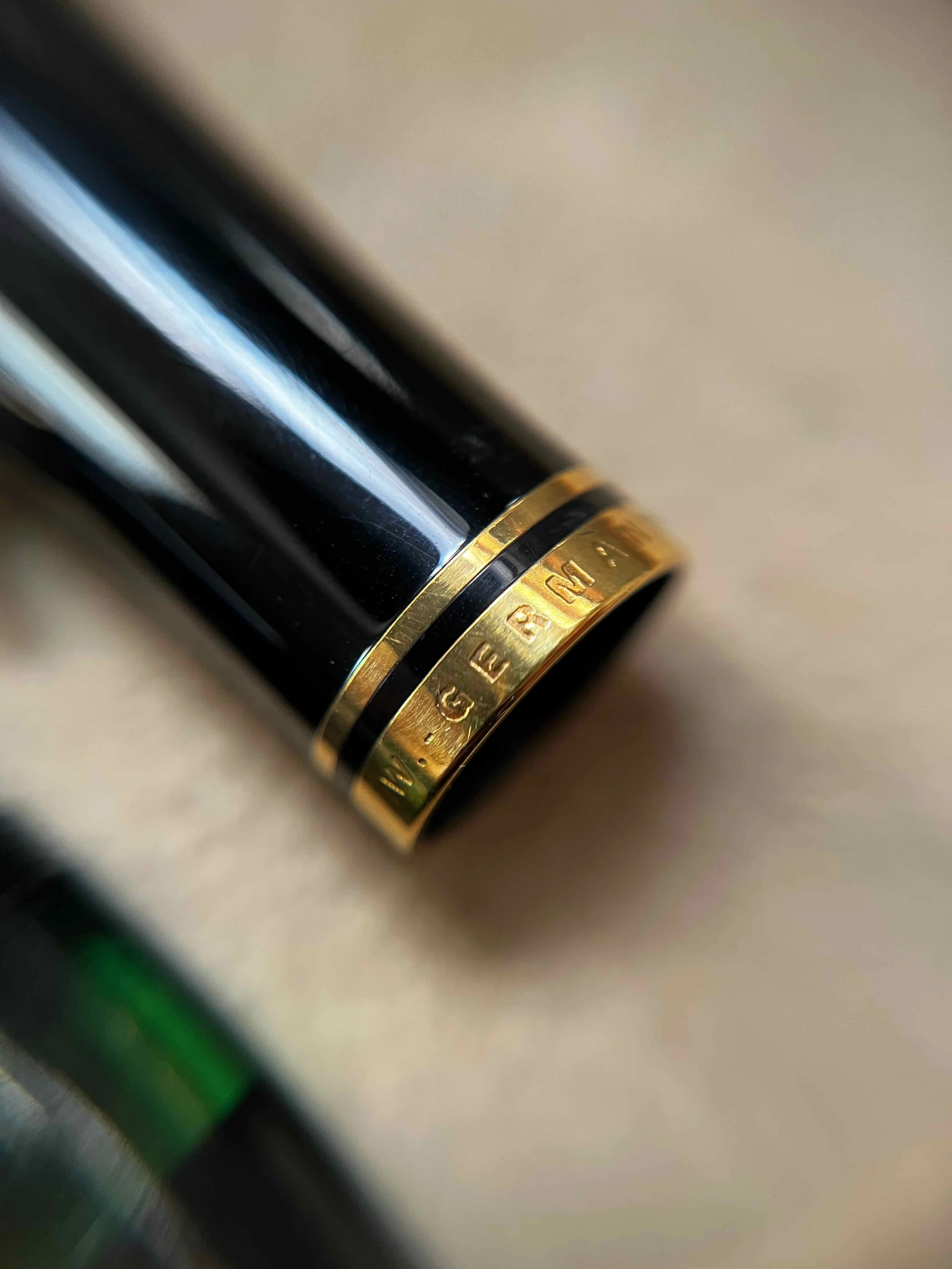
Pelikan’s cold war era engraving.
Fortunately, a second clue can be found in the nib's alloy, 14C instead of the more common 18C. I have seen some sources that specify this indicates a first year production, which puts it somewhere between 1987/1988. According to Danley's article, however, Pelikan's past catalogue indicates that the 14C was used in the M800 up until 1990.
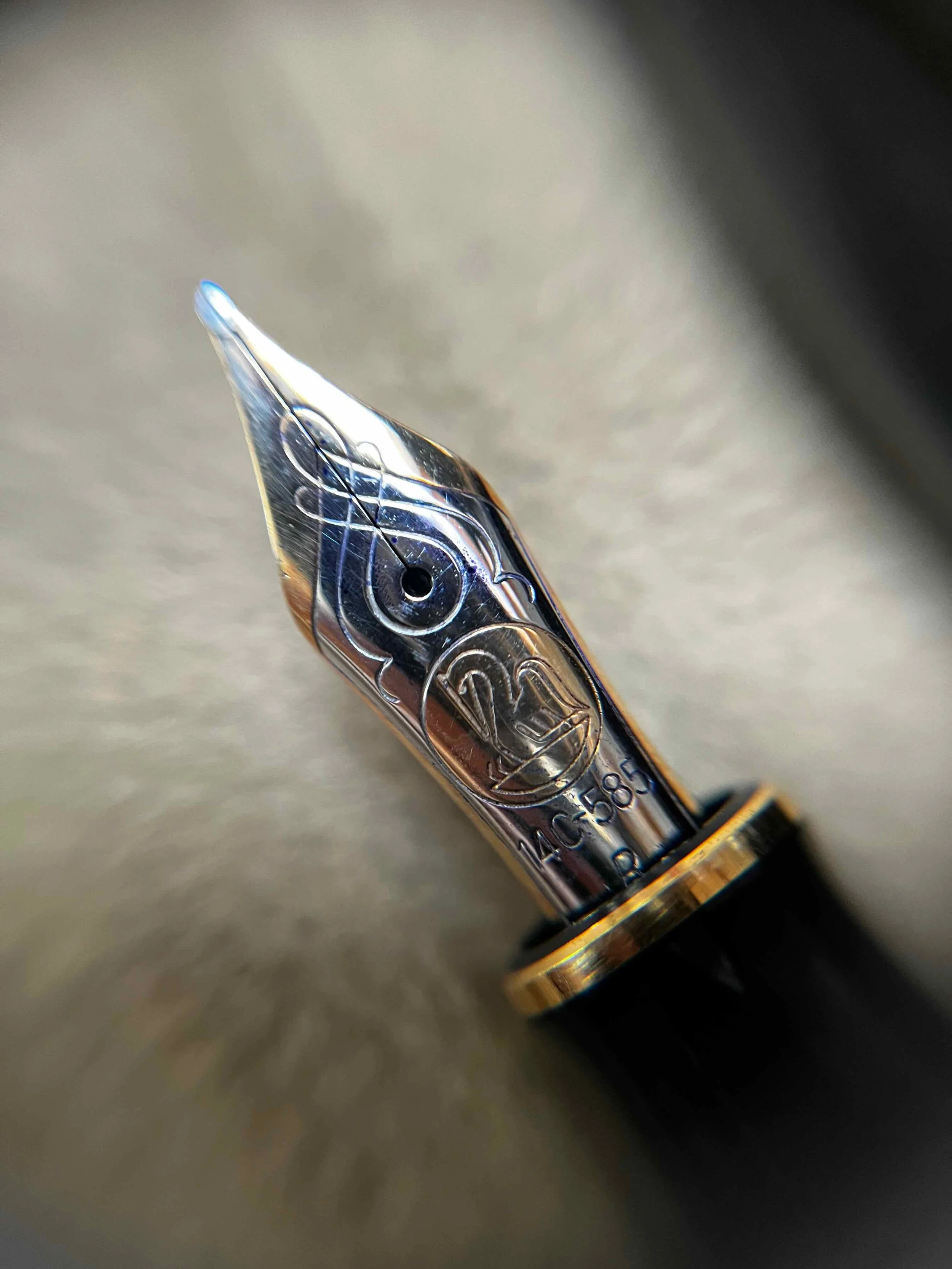
The M800’s 14C nib.
There's enough evidence to confidently date my Pelikan as a 1987-1990 production.
Using the M800
Like most of my fountain pens, it comes in a black body.
Most of the time, I want the pen I'm writing with to fade into the background and let me focus on the work. Some of my pens don't do that; the Waterman 52 and the Pilot Custom Urushi in vermillion come to mind. Most of the others do a decent job at it.
However, none of them do it as well as the M800.
It's large enough to settle in the hands when writing over long periods of time. The brass piston housing also adds a significant weight to the back of the pen. Yet, despite its size and weight, it doesn't impose itself like a Montblanc 149.
The cap makes a satisfying sound when you remove it, thread it back on, or post it.
The feed provides plenty of ink.
The 14C nib is springy but not soft. I find the spring pleasant, and it helps maintain a sort of momentum—especially if you write cursive—that makes you want to keep writing.
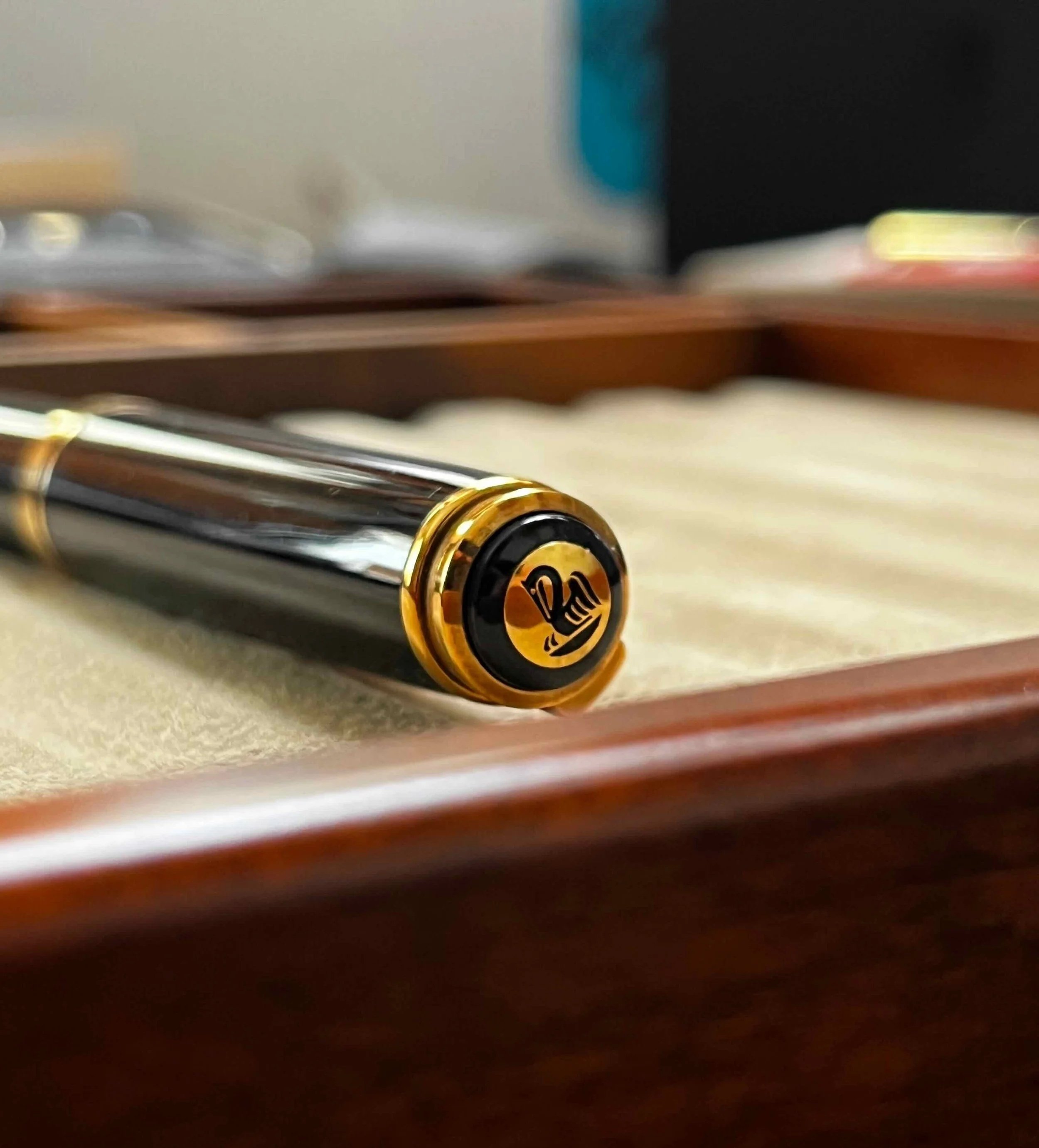
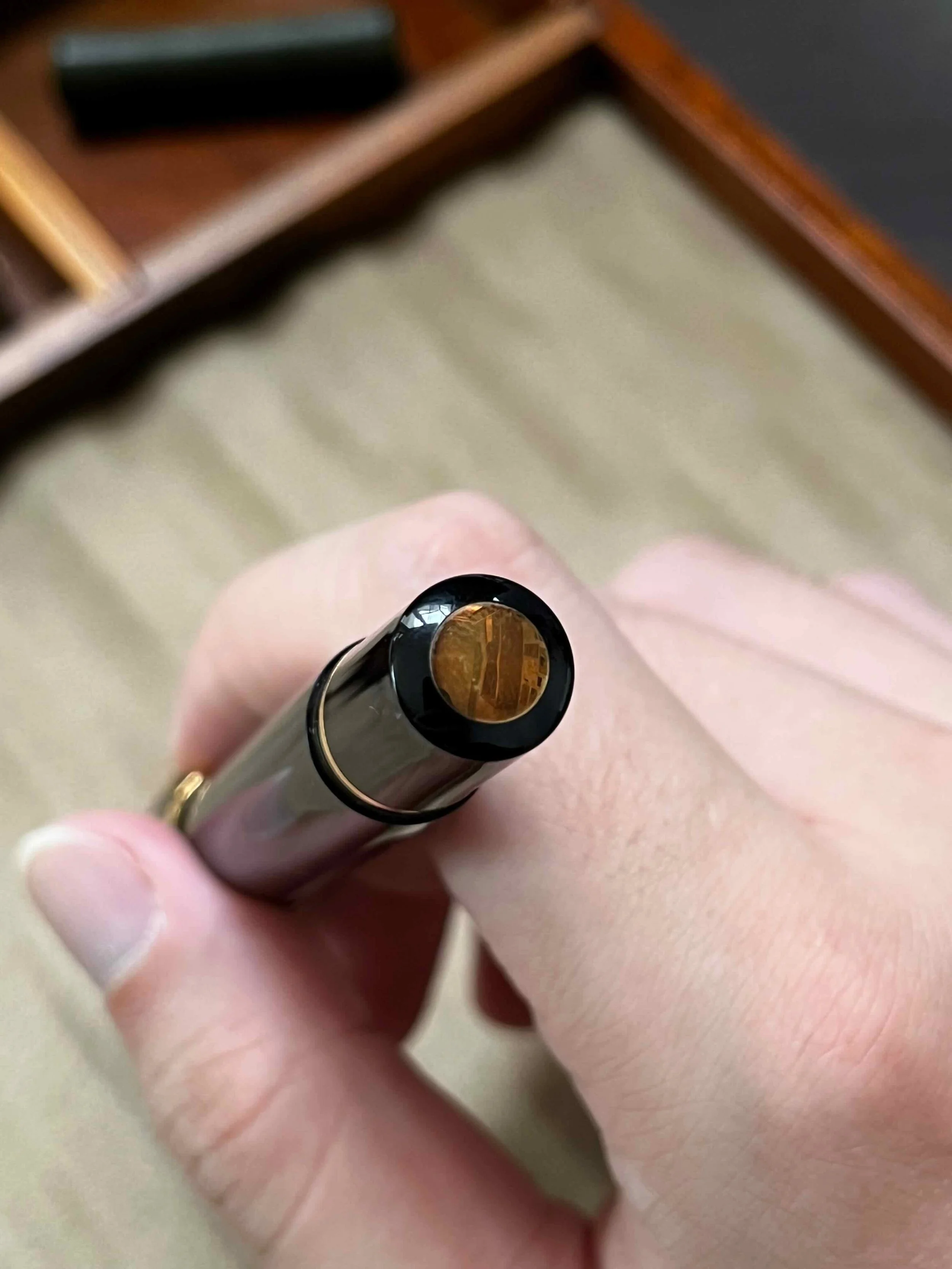
Another distinguishing component of the early M800’s: brass medallions on the cap and piston knob.
All of the above qualities make the M800 a good pen. What makes the M800 great, however, is how it holds up to everyday use.
I don't think twice when I put the M800 in a bag with my laptop, keys, and other items. The construction is sturdy, and while it has lost a bit of its lustre, I find the black resin has held up well. I've polished it before, and I'm confident it will survive another round.
Over the week, I would use it to take notes, bring it on flights with the barrel half-empty, leave it unused for a few days, and it would write immediately when I want it to. It has never leaked on me once.
The M800 writes like an expensive pen, and it has the price tag of one. Yet, I never feel precious about using it. When I need to take it apart and give it a proper cleaning, I don't have the same anxiety as I do when disassembling a Pilot 823.
When I write with the other aforementioned 'luxurious' pens, I feel conscious of the act. It induces a level of anxiety. Not so much with the M800.
All of these 'everyday usability' qualities could be had with pens that cost a lot less. A Lamy Safari or a TWSBI Eco does the same job, and in my experience, they write just as well. But none of them have quite the same feel in the hand.
With quality items, it's always in the details. How it sits in the hand after a few pages, the finish on the threads, the spring on the nib. But most importantly, even after years of use, it still satiates you every time you pick it up.
Maybe most of this is due to the fact that my M800 is already decades old, and it carries the scars to prove it. Adding a few more won't really alter its cosmetic appearance. I highly doubt I can fetch a good price for it.
But in a hobby where possessions can quickly become objects of admiration or desk ornaments, the M800 remains a tool. A very personal one.
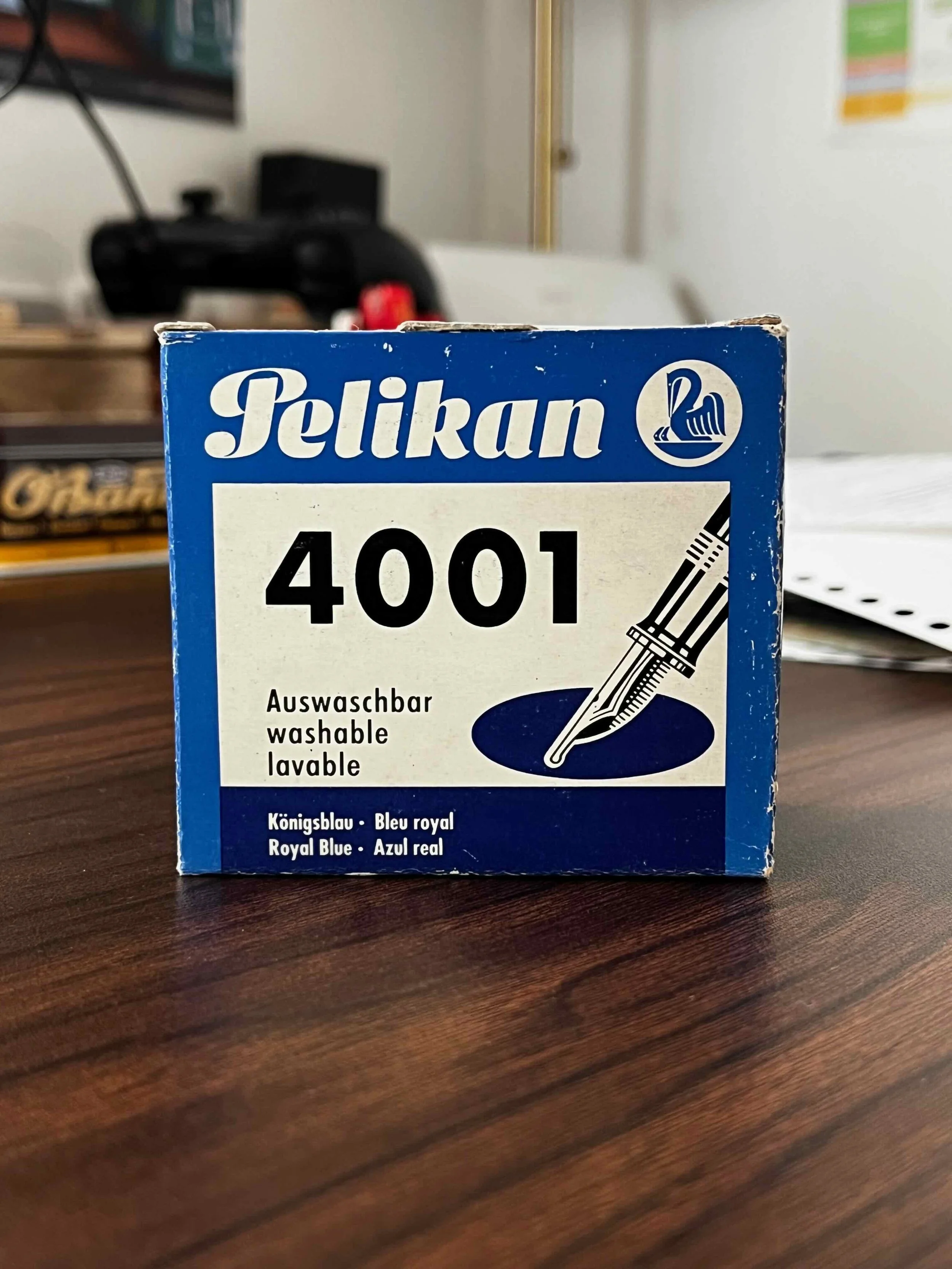
—Pelikan M800, Pelikan Royal Blue
-
September 2026
- Sep 28, 2026 The Montblanc in the Attic
- Sep 24, 2026 Pelikan M800
- Sep 10, 2026 Hotel Stationery: Tokyo Station Hotel
-
August 2026
- Aug 29, 2026 Sakura Craft Lab 001
- Aug 17, 2026 1969 Sailor Mini 21
-
July 2026
- Jul 20, 2026 The Pen Case I Have in Mind
- Jul 8, 2026 Kyoei’s Kiwami Writing Mat
-
June 2026
- Jun 22, 2026 In Defense of the Converter
- Jun 12, 2026 Sailor King Profit
- Jun 5, 2026 Komeda’s Coffee in Bali
-
May 2026
- May 16, 2026 Japanese Ateliers (III): Kato Seisakusho
-
April 2026
- Apr 26, 2026 Pelikan 400NN
- Apr 12, 2026 On Ebonite Feeds
-
March 2026
- Mar 26, 2026 After the Ink Is Gone
- Mar 22, 2026 Hotel Stationery: The Langham Hong Kong
- Mar 19, 2026 Hotel Stationery: The Aman Tokyo
-
February 2026
- Feb 22, 2026 Japanese Ateliers (II): Hakase
- Feb 14, 2026 Japanese Ateliers (I): Nakaya
- Feb 7, 2026 The Price of Writing in Gold
-
January 2026
- Jan 31, 2026 The True Heir
- Jan 24, 2026 Lifestyle