
There are three types of fountain pen makers.
Those a casual user will inevitably encounter: Sailor, Pilot, Platinum, etc. (I).
Those that only an enthusiast with time spent in the hobby would discover (II).
Finally, those that require an enthusiast to go off the beaten track (III).
This series will cover makers in categories II and III. The niche within the niche. The donut hole within a donut’s hole.
Stylo Art Karuizawa (Category II)
On the foothills of Mt. Asama, a little north of Kita-Karuizawa, lies Stylo Art Karuizawa. Founded in 2009, Stylo Art is a workshop specializing in wooden fountain pens. The pair behind Stylo Art, Motoshi and Shuko Kazuno, is a husband and wife team. They can often be seen together at pen shows across the globe.
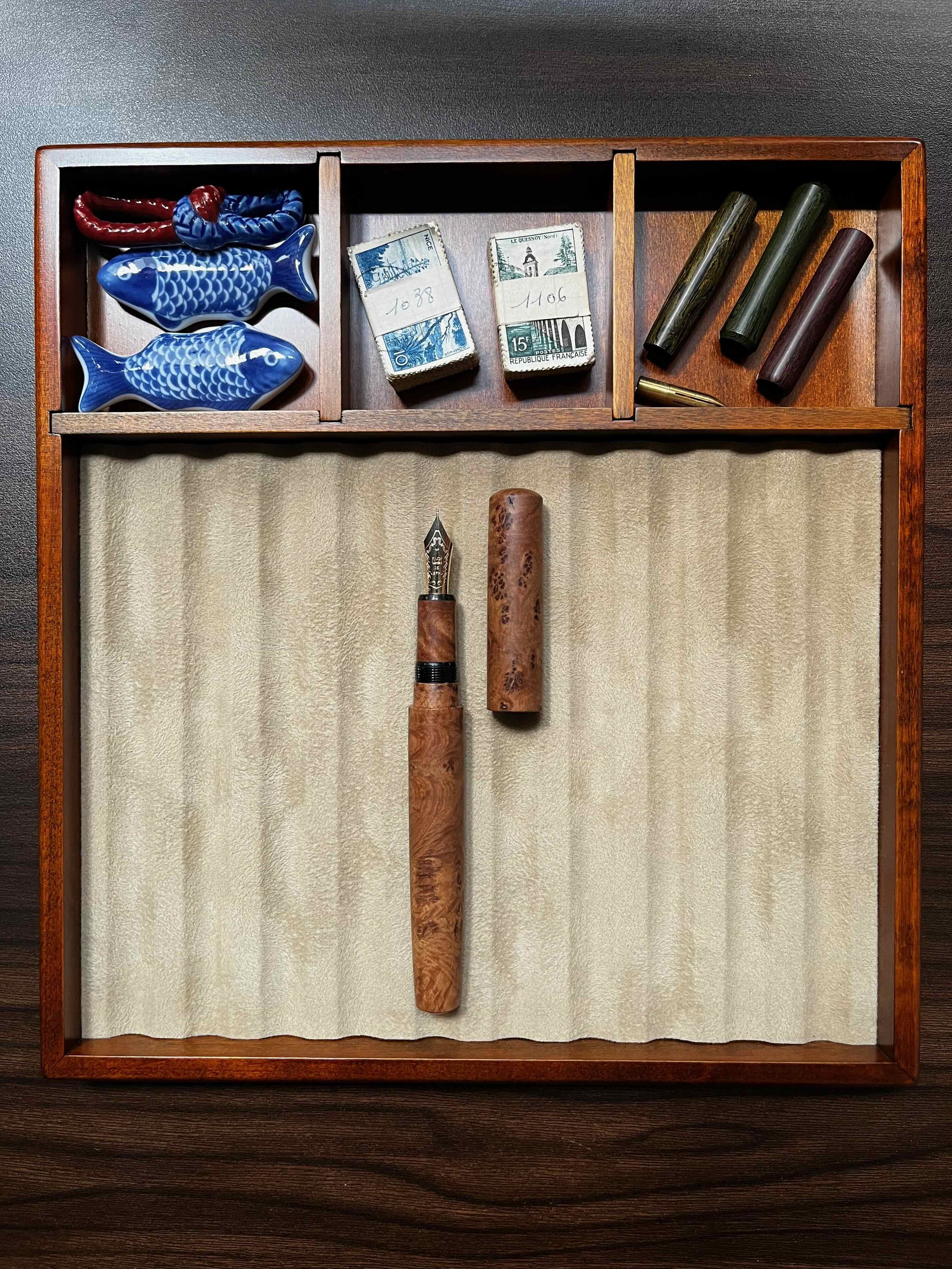
Stylo Art’s Akagi made from Australian Goldfield Burl. It sports a Pilot #15 nib.
Mr. Stylo Art, Motoshi, had undergone multiple career evolutions before settling as a fountain pen craftsman. He was once a salaryman in Tokyo. He then opened his own furniture workshop, ‘Furniture Workshop Kazuno’. I have yet to discover how the transition to fountain pens unfolded. Ms. Stylo Art, Shuko, supports her husband’s endeavour by making kimono sleeves and responding to any online inquiries.
Watching them man a table during pen shows is almost heartwarming. Motoshi’s joviality and Shuko’s warmth bring life to their table. From Shuko’s smile whenever her husband speaks, it is clear that she highly regards his work.
Most of Stylo Art’s models are named after the landscape around Karuizawa. Asama, Shirane and Kazawa are names of mountains. Akagi and Haruna are two of Gunma’s three famous peaks, and Agatsuma is the county and river nearby. The exception is Taut, named after the German architect Bruno Taut, who spent two years in Takasaki.
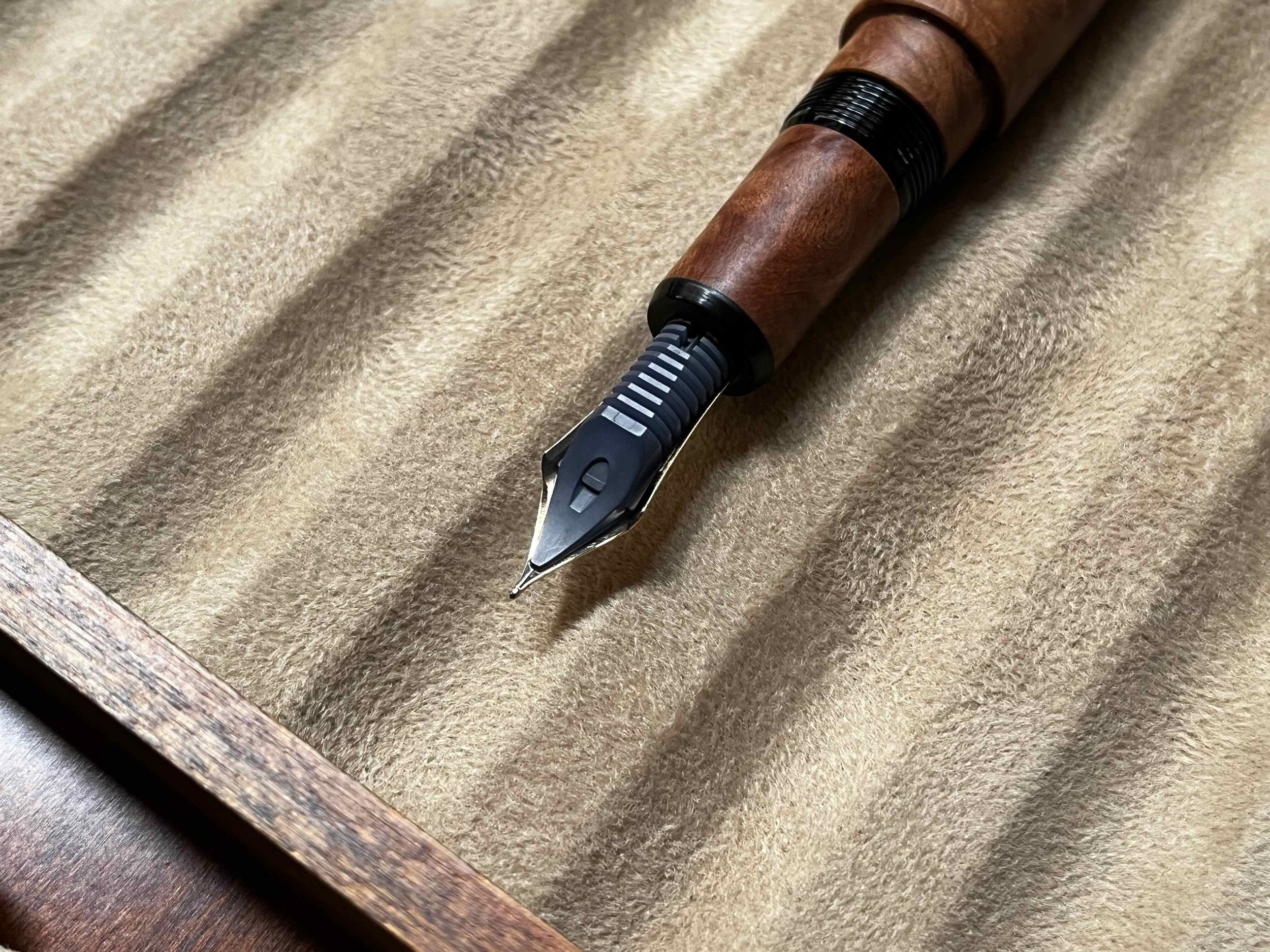
The feed on the Akagi is the same as those found on Pilot’s Custom 743, 823, and 845.
The woods come from further afield. Alongside ebony, cocobolo and snakewood are Japanese species: black persimmon, yakusugi, wild cherry from Karuizawa, among others. Most are finished in oil and wax. Others get fuki-urushi, wiped lacquer that Motoshi-san applies himself. Some are first stained with fountain pen ink.
There are many things that separate Stylo Art from other pen makers. The method with which they source their nibs stands out the most. As far as I know, after Masahiro switched to JoWo nibs from Pilot, Stylo Art is the only maker in the world that buys entire pens with the sole purpose of using them as donors.
As of November 2026, Stylo Art’s catalogue offers eight wooden pen variants with Pilot #15 nibs, along with variants for Sailor’s KOP nib, Pilot’s Capless nib, Pilot’s Elite nib, and Pilot’s Elabo nib. For each of these nibs, Motoshi-san purchases an entire pen, performs surgery, and discard their barrel.
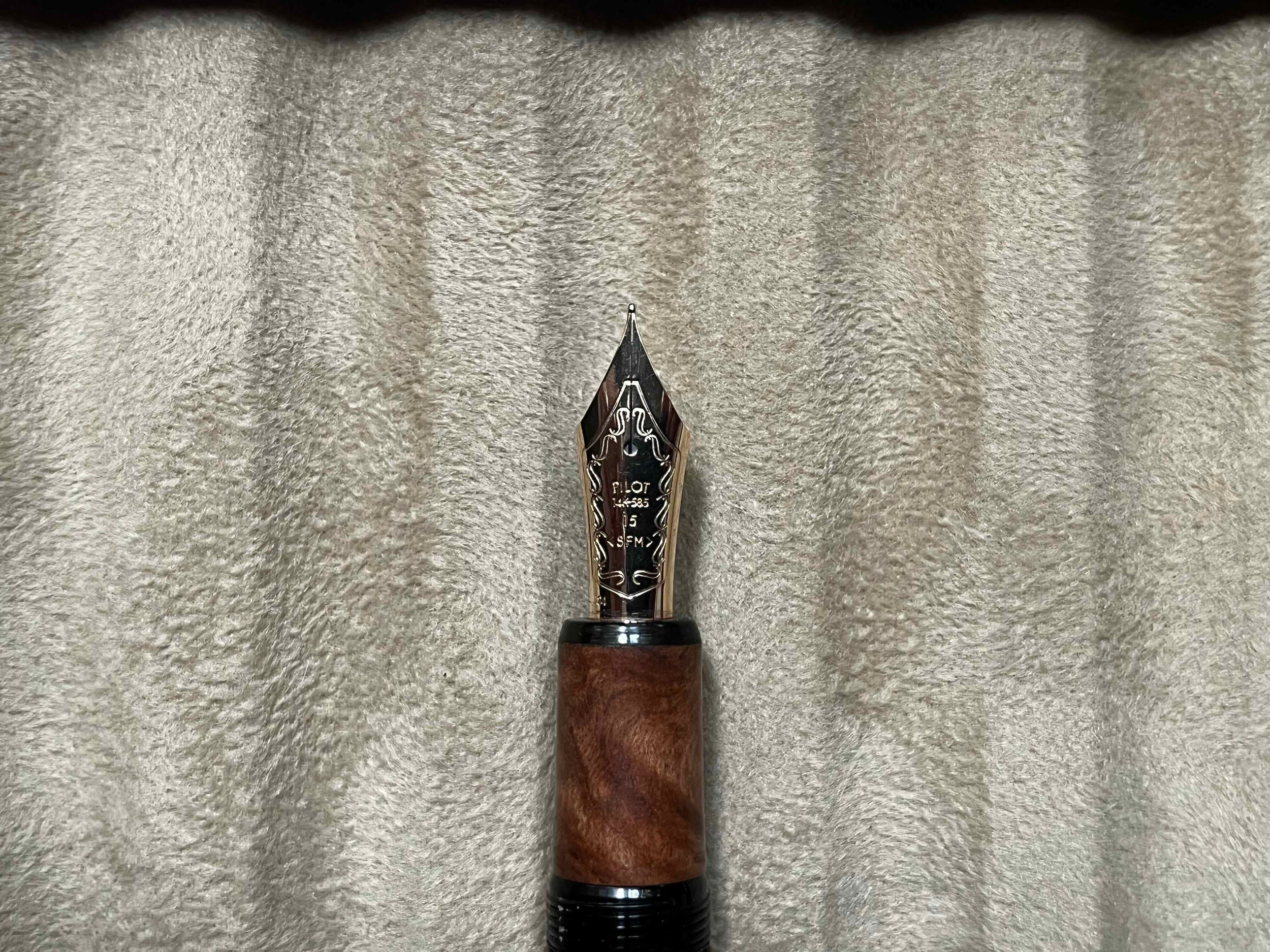
The Akagi’s Pilot #15 nib in SFM. Most likely harvested from a Pilot Custom 743.
I can speculate on many reasons for Stylo Art’s approach. Working capital, production flexibility, and complex supplier relationships are some of them. But the encounter I had with Motoshi-san may have captured it better than any explanation:
I was sitting at his table, inspecting the many wooden barrels by weight, pattern, smell, and feel. Having settled on a wood that originated from Australia, it was time to pick a nib. I asked if Motoshi-san could adjust the nib for me if it wasn’t to my liking. His response was along the lines of “with Pilot nibs, I don’t need to”.
When it comes to quality control, Pilot is arguably the best in the business. Even German companies like Lamy, Montblanc, and Pelikan would struggle to match their consistency and low defect rate.
There’s also the matter of Pilot’s writing taste, which many people rave about (the 823, anyone?). It makes sense for a small maker like Stylo Art to rely on Pilot nibs. Nib defects would be detrimental to an independent maker’s reputation.
It’s a shame that, except to Hakase, Pilot does not sell nibs and feeds on their own. If they do, I suspect many other independent pen makers would opt for Pilot nibs.
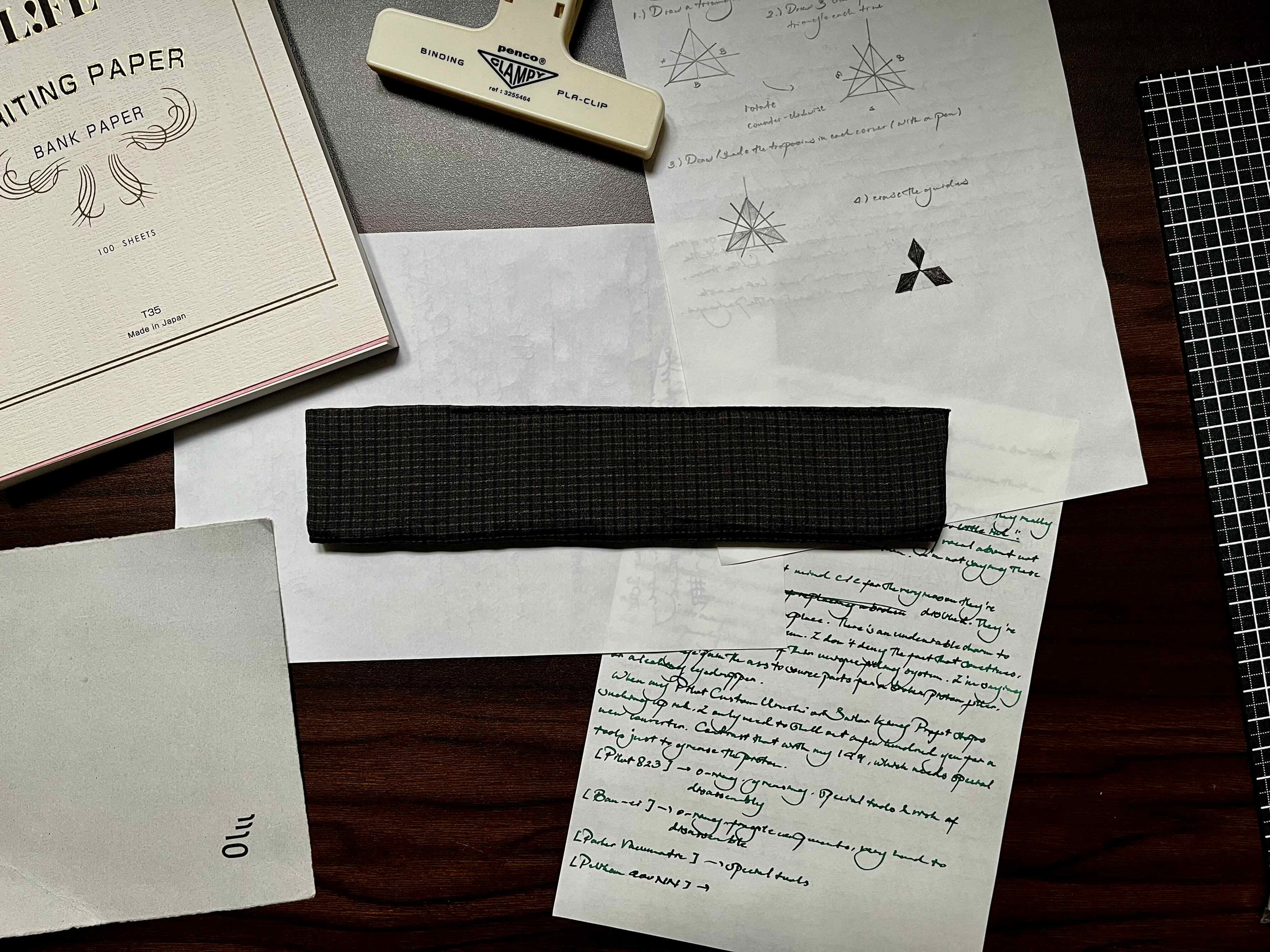
The kimono sleeve made by Shuko Kazuno.
Regardless, purchasing pens new to harvest their parts isn’t exactly the most economical way of doing things. It reads as something done on principle.
The pen I purchased from Motoshi-san is the Akagi model. It is made out of Goldfield Burl, and it sports a Pilot #15 Soft Fine Medium. It utilizes a Pilot CON-70 converter.
Length (capped): ~153 mm
Section diameter: ~12 mm
Approximately six months after I purchased the pen, the glue holding the barrel to the inner structure gave out. I wrote to Shuko-san, explained the issue, and asked if I could fix it myself. She replied within a day and asked for photos. The day after, Motoshi-san had his diagnosis and identified the material I would need to fix it. They then sent it by mail, accompanied with some videos of Motoshi-san performing the repair in his workshop while relaying instructions.
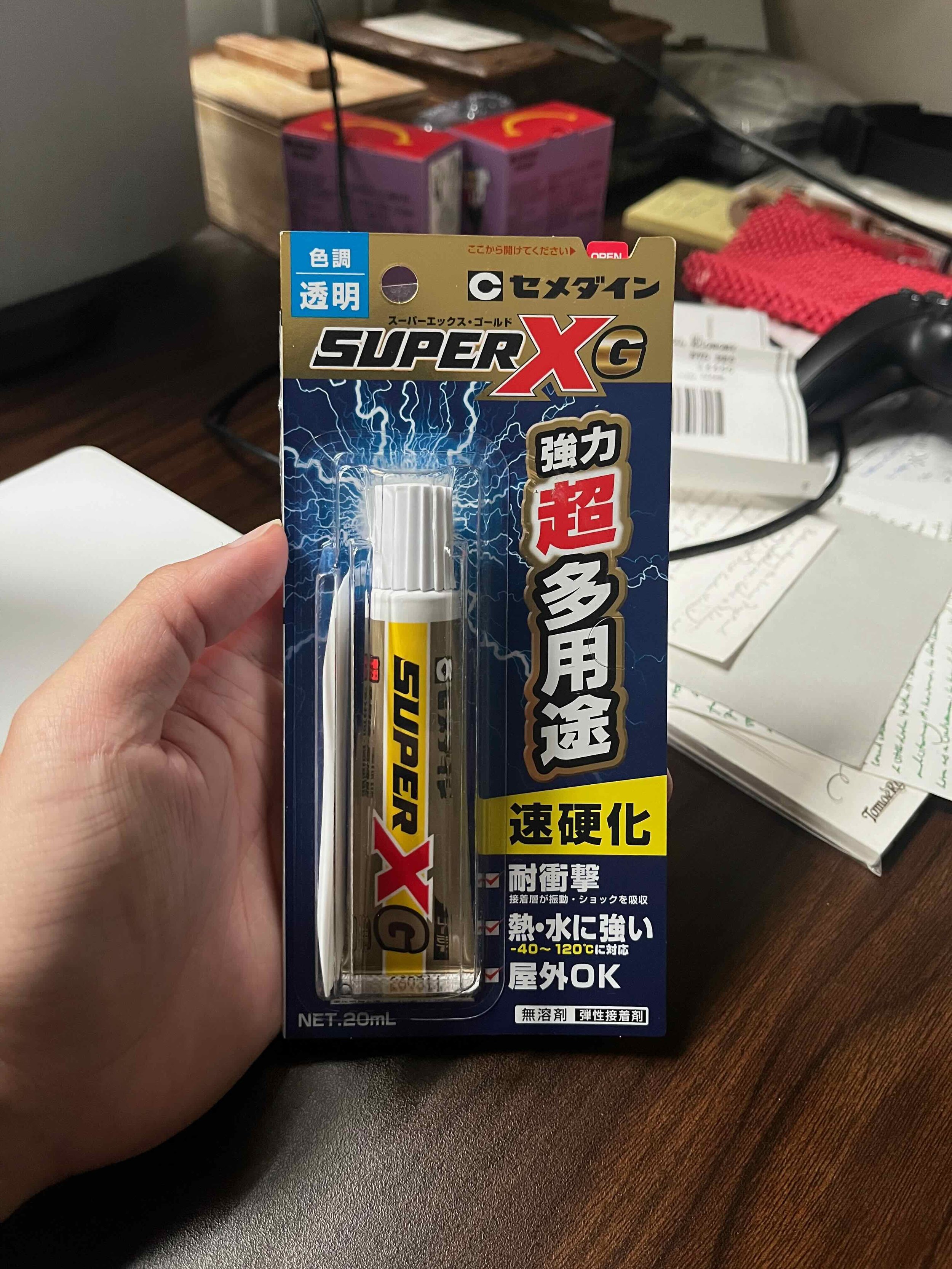
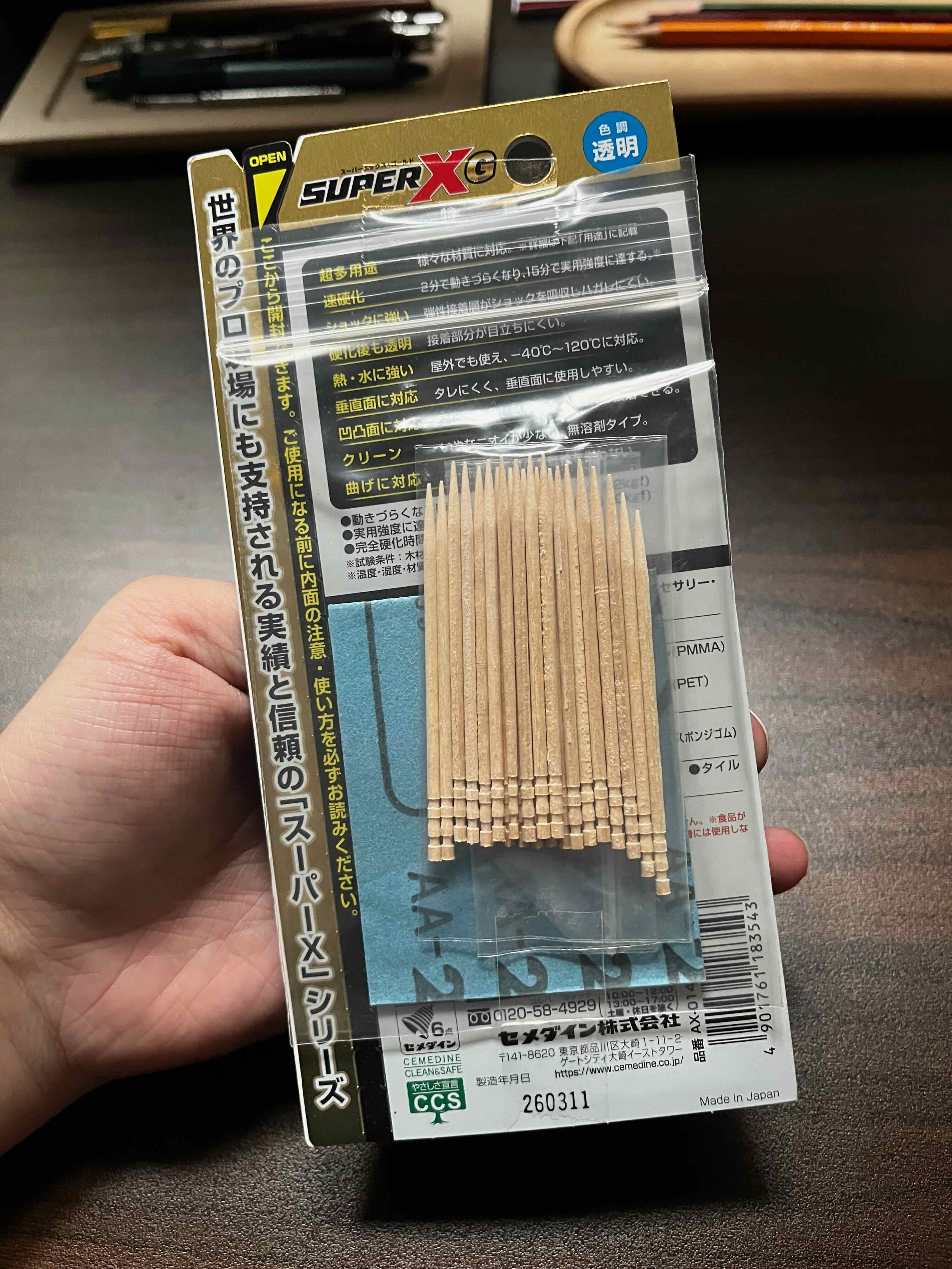
The repair kit sent by Stylo Art: Cemedine Super XG, sandpaper, and toothpicks.
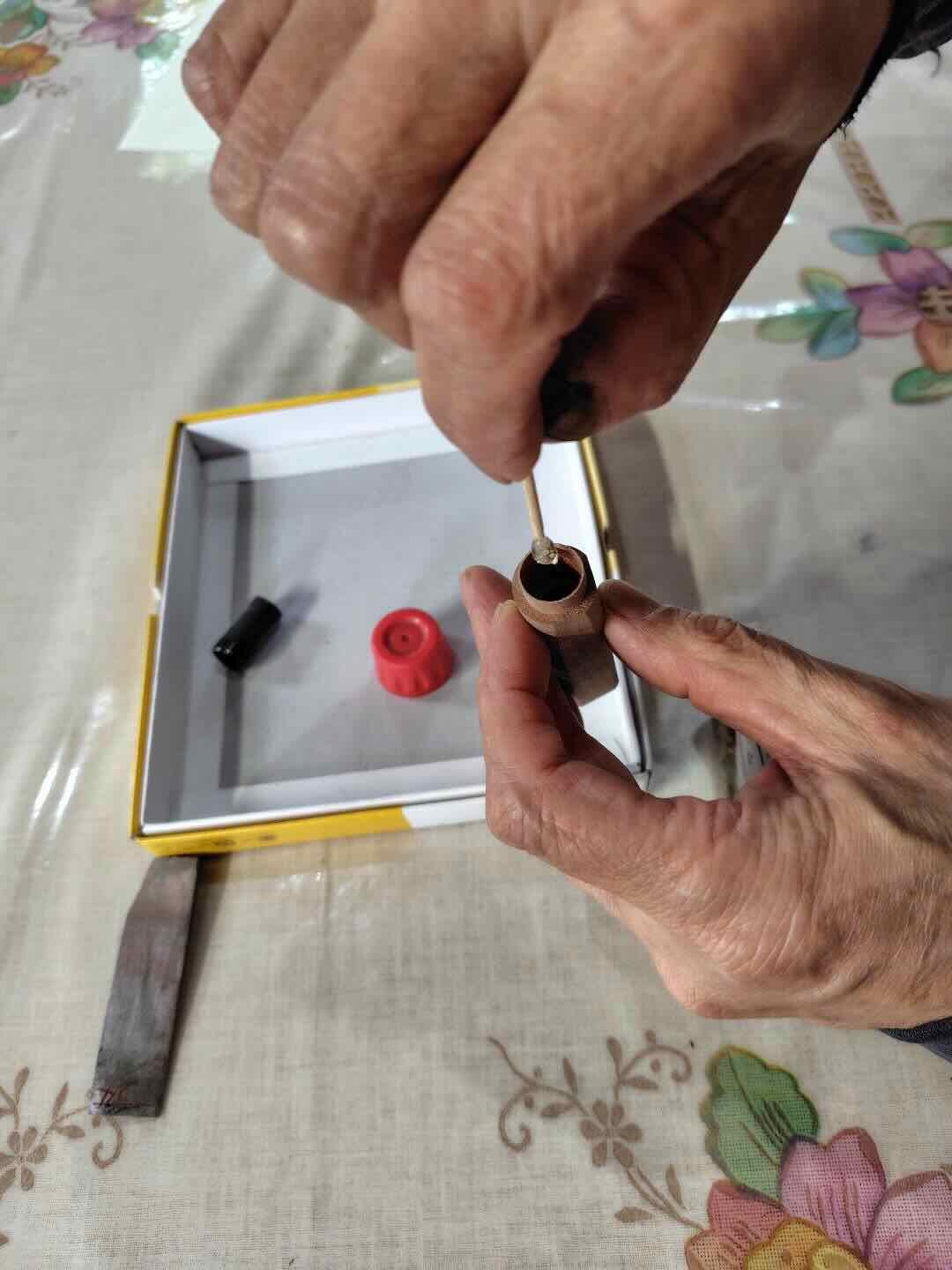
Motoshi-san demonstrating how to repair the pen.
I managed to fix the pen. I have the feeling that any other maker would have refused and insisted on having the pen sent back.
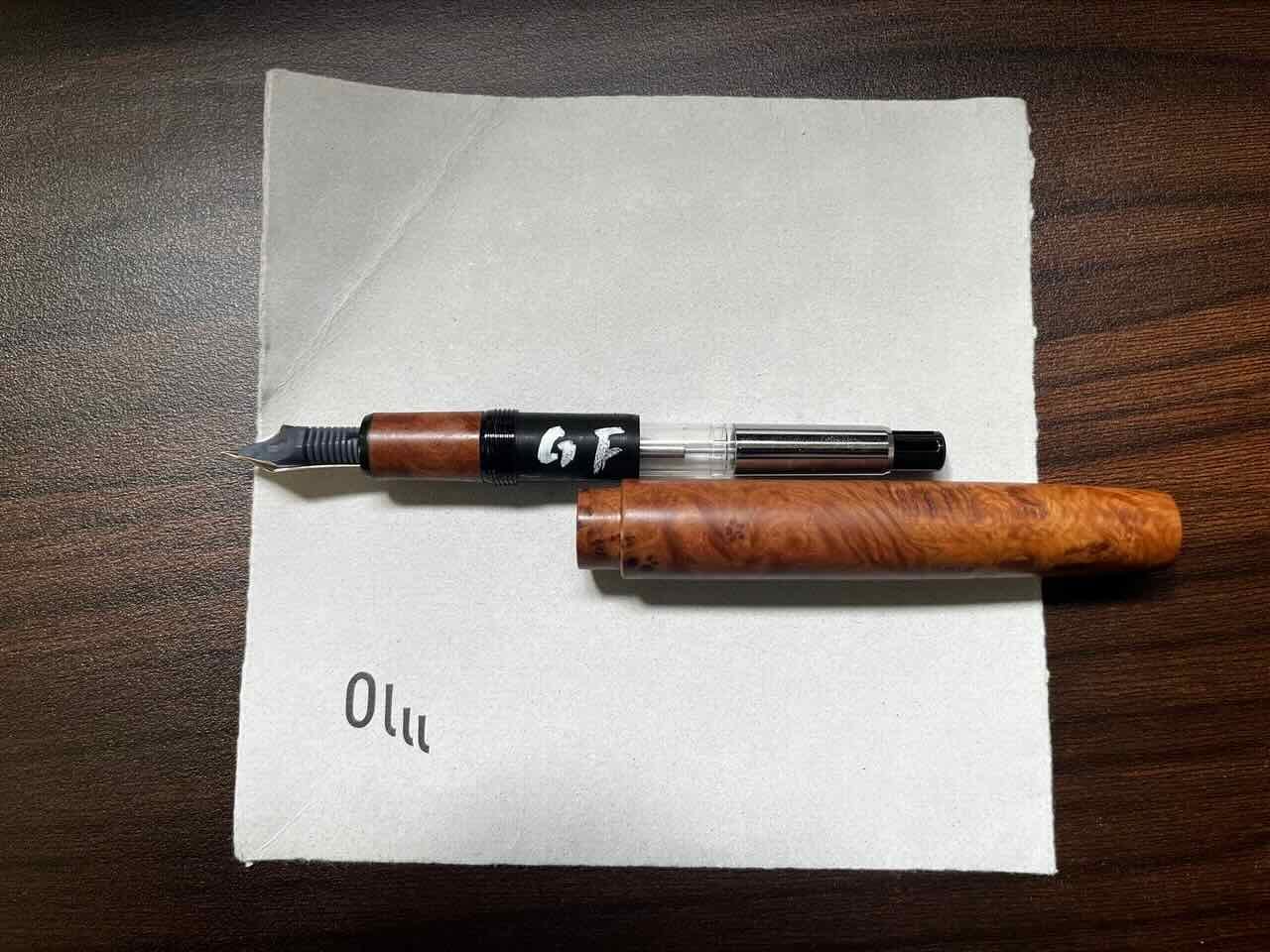
The Akagi before the repair.
The Akagi after the repair.
On paper, my Stylo Art Akagi is just a wooden barrel fitted with a Pilot nib. But there’s something more to it now. Something Motoshi-san and Shuko-san added when they went through all that trouble of making sure I could fix the pen myself.
It could just be my fondness for Motoshi-san and Shuko-san, whose eyes lit up when I revealed that my parents also made wooden furnitures for a living.
Whatever it is, it originated from a workshop in the foothills of Mt. Asama. Made by a man who underwent multiple careers before finding his calling. And a supportive partner that made it all possible.
Category II.
—Stylo Art Akagi, Bungubox Ink of the Witch
-
November 2026
- Nov 18, 2026 Japanese Ateliers (IV): Stylo Art Karuizawa
-
October 2026
- Oct 13, 2026 Who Will Tend the Nibs?
-
September 2026
- Sep 28, 2026 The Montblanc in the Attic
- Sep 24, 2026 Pelikan M800
- Sep 10, 2026 Hotel Stationery: Tokyo Station Hotel
-
August 2026
- Aug 29, 2026 Sakura Craft Lab 001
- Aug 17, 2026 1969 Sailor Mini 21
-
July 2026
- Jul 20, 2026 The Pen Case I Have in Mind
- Jul 8, 2026 Kyoei’s Kiwami Writing Mat
-
June 2026
- Jun 22, 2026 In Defense of the Converter
- Jun 12, 2026 Sailor King Profit
- Jun 5, 2026 Komeda’s Coffee in Bali
-
May 2026
- May 16, 2026 Japanese Ateliers (III): Kato Seisakusho
-
April 2026
- Apr 26, 2026 Pelikan 400NN
- Apr 12, 2026 On Ebonite Feeds
-
March 2026
- Mar 26, 2026 After the Ink Is Gone
- Mar 22, 2026 Hotel Stationery: The Langham Hong Kong
- Mar 19, 2026 Hotel Stationery: The Aman Tokyo
-
February 2026
- Feb 22, 2026 Japanese Ateliers (II): Hakase
- Feb 14, 2026 Japanese Ateliers (I): Nakaya
- Feb 7, 2026 The Price of Writing in Gold
-
January 2026
- Jan 31, 2026 The True Heir
- Jan 24, 2026 Lifestyle