
Japanese Ateliers (III): Kato Seisakusho
NOTE: This article was made possible by Mr. Takahiro Itoda (糸田 敬弘), who opened his archive—catalogues, photographs, pens—without hesitation. Whatever is accurate here is owed to him. Whatever is not is mine.
There are three types of fountain pen makers.
Those a casual user will inevitably encounter: Sailor, Pilot, Platinum, etc. (I).
Those that only an enthusiast with time spent in the hobby would discover (II).
Finally, those that require an enthusiast to go off the beaten track (III).
This series will cover makers in categories II and III. The niche within the niche. The donut hole within a donut’s hole.
Kato Seisakusho (Category III)
Up until this point, I have only discussed active and relatively well-known fountain pen makers in both Nakaya and Hakase. Today’s subject is none of those things.
Kato Seisakusho (カトウセイサクショ / 加藤製作所) was a fountain pen workshop in Osaka’s Ikuno Ward. To understand the importance of Kato Seisakusho, we must first peek into the life of its former proprietor, Kiyoshi Kato (加藤清). The story most often told about Kiyoshi Kato begins with a shovel.
Kato was born in 1926 in Shojihigashi, Osaka—three years after the Great Kanto Earthquake. His father had established Kato Seisakusho around the time Kato was born. Before or during the war, the business amassed a sizable stock of celluloid rods. To protect the material from Allied bombings, the rods were buried in the backyard. Kato unearthed them after the war and used them to teach himself the craft of turning celluloid rods into pens.
By Kato’s own account, craftsmen of the time forged their own tools out on the streets on their days off, using the unpaved roads as workspace. Out in the open, knowledge passed between masters and apprentices, and Kato eventually became a master of the lathe.
Birth of a Spaceman, 1961
Around 1961, Kato launched the brand Space Man, aimed at the export market. The line included fountain pens, mechanical pencils, ballpoint pens, and lighters. The name almost certainly drew from the Space Race, then in full swing. Around the same period, Kato set up a factory in Alexandria, Egypt, though it is not entirely clear which of his brands it was attached to, or whether it was his at all.
A catalogue archived by Takahiro Itoda (糸田 敬弘), the foremost archivist of Kato’s work, shows that Space Man products were marketed as Made in Japan. Whether anything was actually being made in Alexandria and finished in Japan is anyone's guess. Modern luxury brands do this constantly, sourcing labour and materials in China and shipping the goods to Italy or France for the final stitch, all to claim a different label. The catch is that Made in Japan, in the 1950s and 60s, was not the badge of honour it is now. It was closer to what Made in China meant a generation ago: cheap, low quality, mass-produced. Japan was a manufacturing hub with industrial clusters built for cost. Egypt was neither. It is hard to imagine Kato going through that much trouble for a label that, at the time, no one wanted.
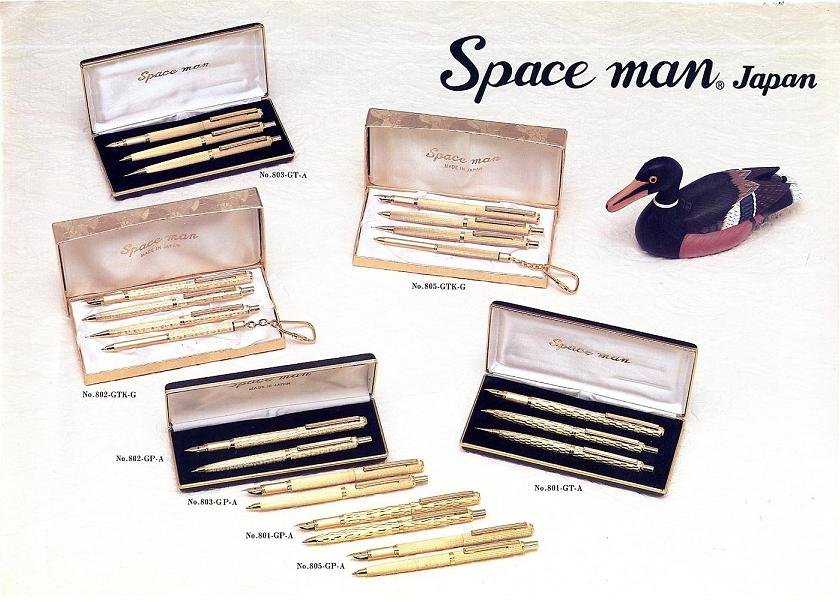
Kiyoshi Kato’s Space Man catalogue, courtesy of Takahiro Itoda (糸田 敬弘).
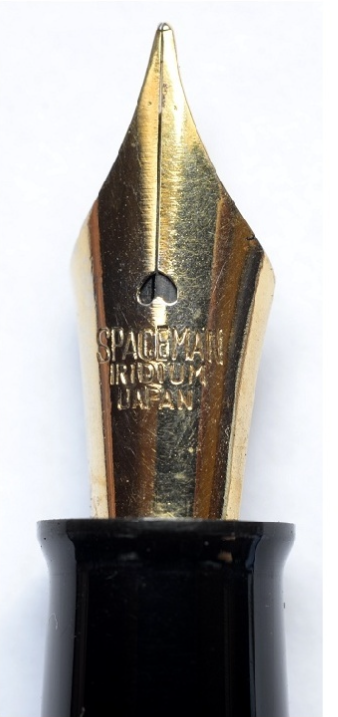
A stainless steel Space Man nib: SPACEMAN / IRIDIUM / JAPAN. Courtesy of Mr. Itoda.
A Space Man-branded celluloid pen does exist. The Space Man line in Itoda-san’s catalogue, however, does not seem to have featured celluloid prominently, if at all. Whatever was happening in Alexandria, it probably wasn't Kato turning pens by hand.
Kabutogi, 1970s
Another chapter of Kato's career involves an encounter with another mythical figure: Kabutogi Ginjiro (兜木銀次郎).
Like Kato, Kabutogi was a prolific craftsman. Kabutogi specialized in nibs and was best known for his work under the Ban-ei (挽栄) name. His nibs remain desirable amongst Japanese fountain pen aficionados. Kabutogi's career is, frankly, an article of its own. Their encounter was possible because of another fountain pen maker, Morison.
Morison (モリソン) had once outsold Pilot, Platinum, and Sailor during World War II. By the 1970s, Morison had largely given up its position in the Japanese fountain pen market. Founder Tanigawa Torajiro (谷川寅次郎) wanted his fortunes restored. A department store in Osaka was asking for higher-end fountain pens, and Morison commissioned both Kato and Kabutogi for what would become the Antique Pen series. According to blogger Yu Tse, the materials included Yakusugi cedar, water buffalo horn, and celluloid. Kato handled the lathe. Kabutogi handled the nibs.
Put simply, a collaboration of this magnitude does not happen—not in a lifetime, not in any field. It would be akin to Babe Ruth and Shohei Ohtani being on the same roster. Fountain pens were still an everyday object at the time rather than a niche hobby. A collaboration of this kind likely went unnoticed. The prices these pens fetch on Yahoo Auction today—in the rare case it does appear at all—suggest the appreciation arrived late.
Visconti, 1990s
Visconti was founded in Florence in 1988. Three years later, in its early period, the company was sourcing celluloid barrels and caps from Kato. Italy has Aurora and Omas, two companies with deep celluloid histories and both on Visconti's doorstep. Visconti had options. That they went to Kato anyway is not nothing. His hand-turned work appeared on the Ragtime (1991), Manhattan (1995), and Pontevecchio (1995).
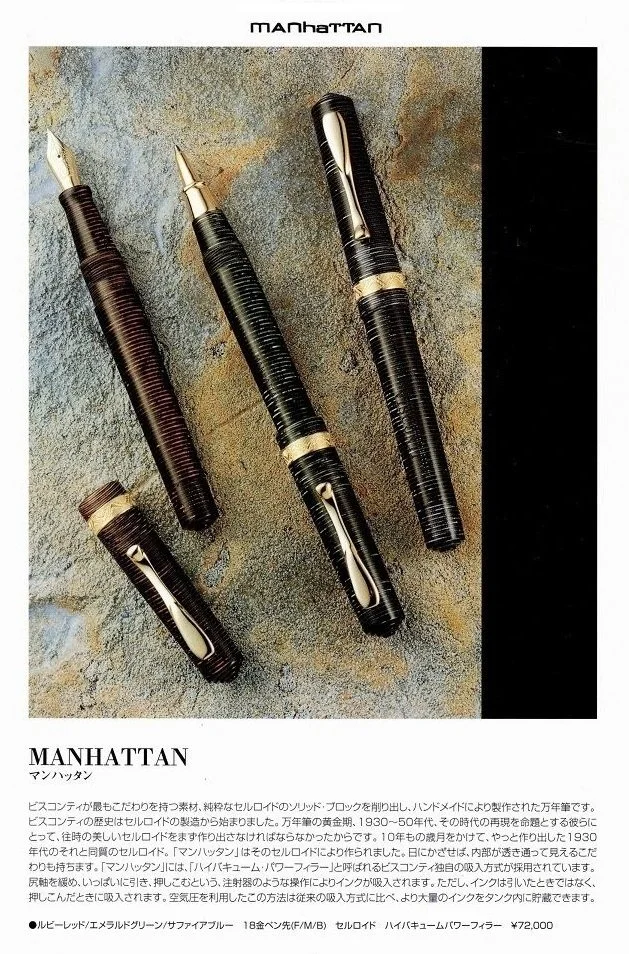
Kiyoshi Kato’s Visconti Manhattan. Courtesy of Mr. Itoda.
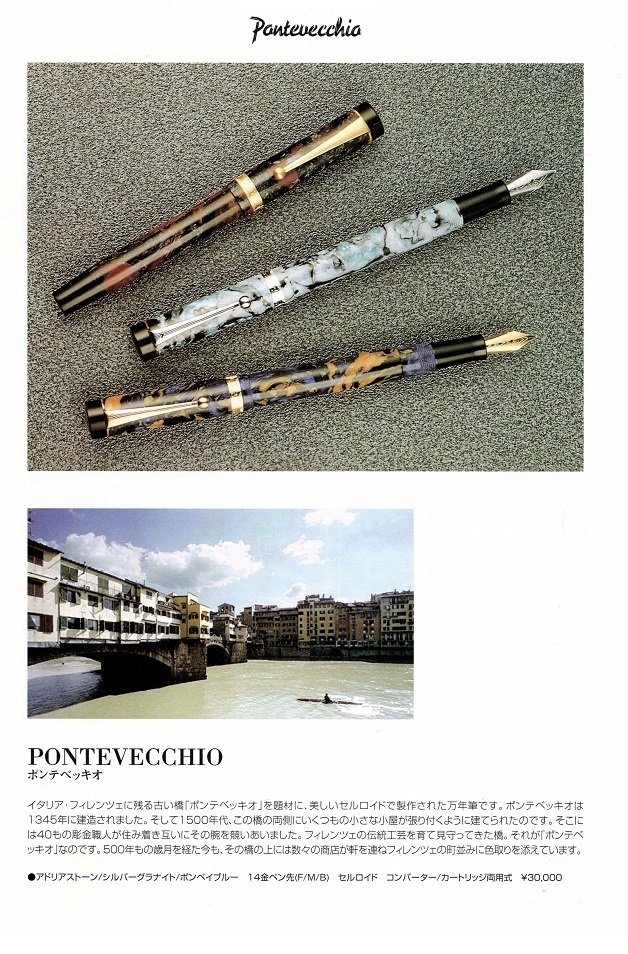
The Pontevecchio. Courtesy of Mr. Itoda.
Conway Stewart placed an order too, though for acrylic resin ballpoint pens rather than celluloid. A facsimile of the order is archived by Itoda.
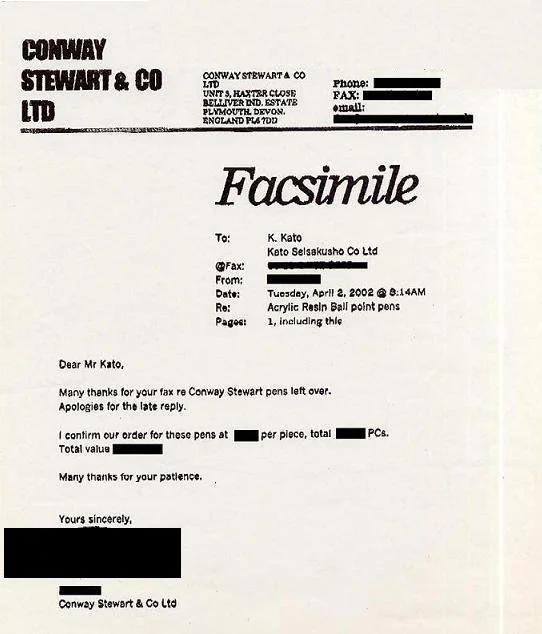
A facsimile between Conway Stewart and Kato Seisakusho for an order of acrylic resin ballpoint pens. Courtesy of Mr. Itoda.
Osaka, 1995
At some point, Kato decided to focus on the domestic market. He was reportedly in his seventies, which puts the date somewhere around 1995. There is a video from 2009 of Kato working in the Osaka workshop alongside his eventual successor Onishi Keizo. Production was still done by hand. Kato spent a portion of the video pulling out his Space Man catalogue and recounting stories from his youth. The material on the lathe at the time of recording was exclusively celluloid, though Itoda's archive shows similar pieces in water buffalo horn and ivory.
Kato's celluloid pens came in many variations. Models come and disappear from his catalogue as time went on. Cataloguing his pens is an impossible task in 2026. That is, if you don’t have Itoda-san’s unparalleled knowledge of Kato. Itoda-san, as he has done many times for this article, contributes once more:
| Model | Price (JPY) | Nib | Filling System | Closed Length (mm) | Posted Length (mm) | Barrel Diameter (mm) | Cap Diameter (mm) | Weight (g) |
|---|---|---|---|---|---|---|---|---|
| 2500 | 26,250 | 14k gold | C/C | 150 | 165 | 14 | 16 | 27 |
| 2000 | 21,000 | 14k gold | C/C | 141 | 160 | 13.5 | 15 | - |
| 1700 | 17,850 | 14k gold | C/C | 136 | 155 | 13 | - | 18 |
| 1600 | 16,800 | 14k gold | Piston-filler | 130 | 150 | 12 | 13.5 | 17 |
| 1500 | 15,750 | 14k gold | C/C | 137 | 157 | 11.8 | 12.6 | 16 |
| 1300 | 13,650 | 14k gold | C/C | 128 | 151 | 11 | - | 15 |
| 850 | 8,925 | Steel | C/C | 144 | 158 | 13.5 | 15 | - |
| 800 | 8,400 | Steel | Piston-filler | 130 | 150 | 12 | 13.5 | 17 |
| 800 | 8,400 | Steel | C/C | 136 | 155 | 13 | - | 17 |
| 680 | 7,140 | Steel | Cartridge only | 117 | 138 | 11 | - | 10 |
| 350 BP Round | 3,675 | Ballpoint | BP refill | 140 | - | 11 | - | 24 |
| 350 BP | 3,675 | Ballpoint | BP refill | 132 | - | 11 | - | - |
| 300 BP | 3,150 | Ballpoint | BP refill | 120 | - | 12 | - | 14 |
| Pencil Extender | 4,725 | Pencil | Pencil refill | 111 | - | 10.6 | 11.8 | 10 |
It’s not my intention to create a definitive reference for identifying a Kato pen with the table above. The dimensions listed are a combination of information from past catalogues and real-life measurements. Decades have passed since, and materials and methods drift over time. My own 2000 would have passed for a 1700 on measurements alone. Only its rounded ends gave it away.
The story of Kato's gold nibs is not a single chapter. The last and most familiar iteration carries the engraving SUPERIOR / 14K / LIFETIME / GRATIFY / JAPAN, widely understood to be Sailor OEM. But Itoda-san's collection complicates the picture considerably.
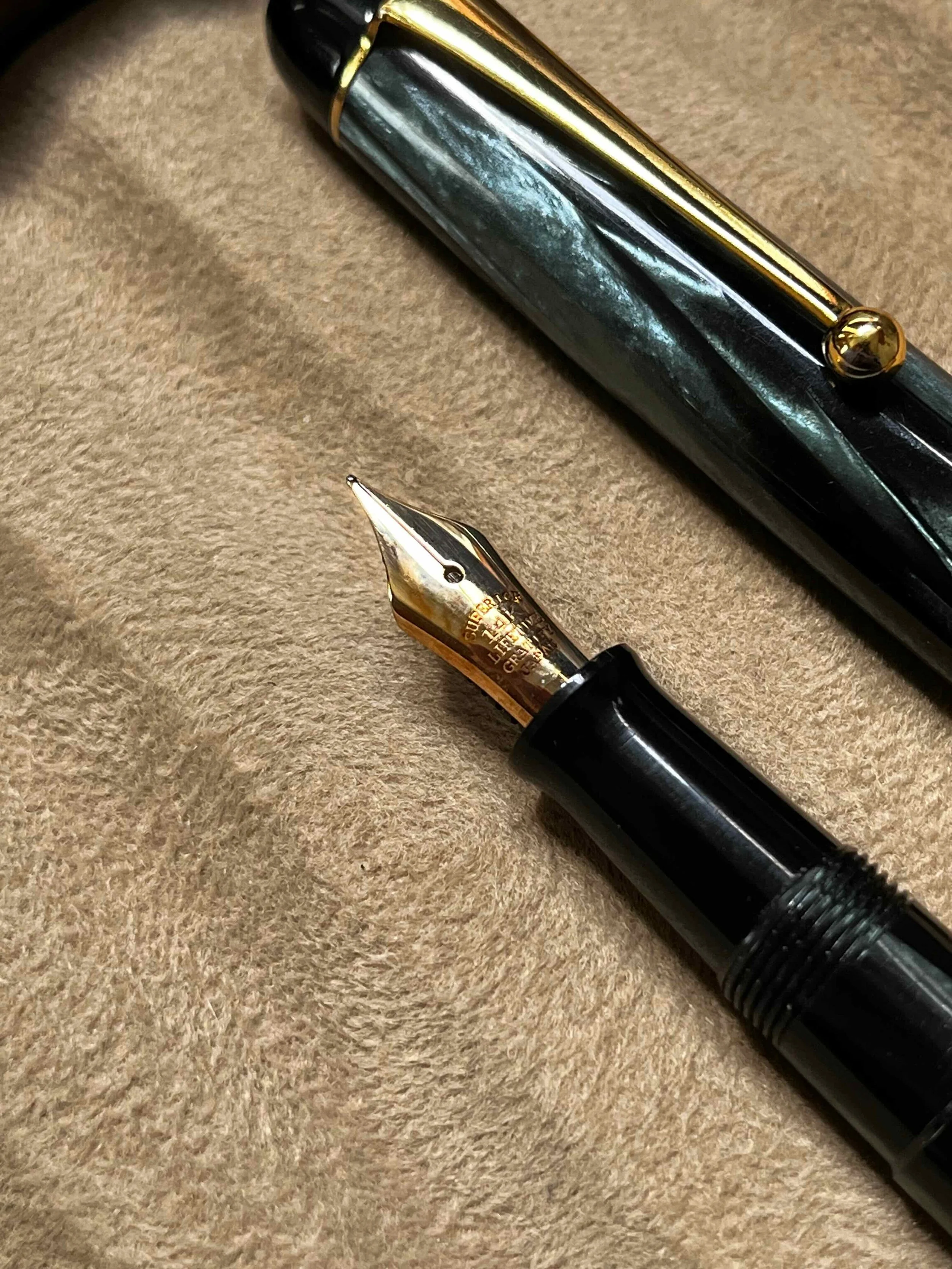
The last iteration of Kato's 14k gold nib. A Sailor OEM bearing the engraving: SUPERIOR / 14K / LIFETIME / GRATIFY / JAPAN. The one most collectors will encounter.
An earlier nib bearing the engraving SUPERIOR / 14K / LIFETIME / YOUR GRATIFY raises a different possibility. The dimensions echo Ban-ei's GK nibs closely enough to invite speculation about Kabutogi's involvement. Perhaps a continued collaboration running parallel to, or beyond, the Morison commission. Without a direct comparison, it remains speculation. But it is not idle speculation.
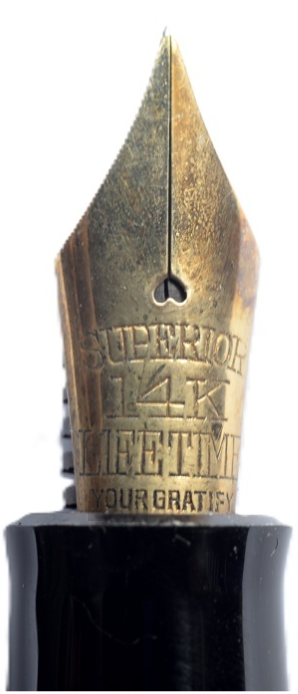
Undercover GK nib? An earlier gold nib carrying the engraving YOUR GRATIFY rather than GRATIFY. Courtesy of Mr. Itoda.
A third nib muddies things further: a 14k piece with a heart-shaped breather hole, a JIS engraving, and what appears to be a Sailor logo at the base. Whether this is a transitional piece, a hybrid, or something else entirely is unclear. What is clear is that the Sailor OEM account, accurate as it may be for the later years, does not capture the full picture.
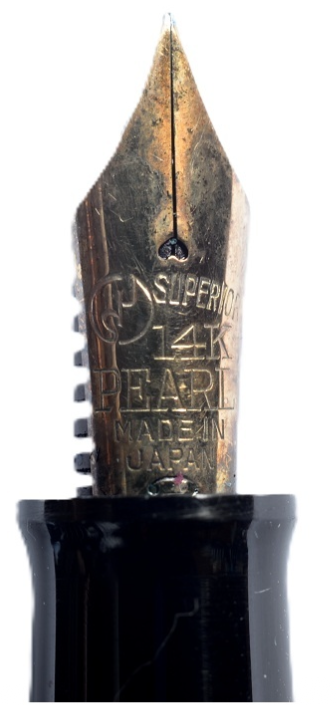
A Sailor nib with a breather hole? JIS / SUPERIOR / 14K / PEARL / MADE IN / JAPAN / Sailor (?)
The steel nibs are a simpler matter: either Schmidt, or an unbranded variant engraved SPECIAL / IRIDIUM / PEN.
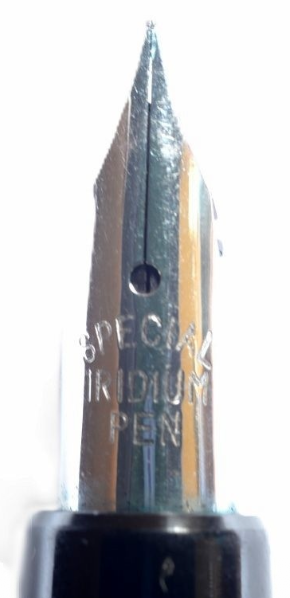
SPECIAL / IRIDIUM / PEN. Courtesy of Mr. Itoda.
Whether Kato made his own ebonite feeds is just as difficult to confirm. The geometry of his feeds is similar to those used by Ishikawa Kinpen Seisakusho (石川金ペン製作所), Ban-ei (挽栄), and Kubo Kogyosho (久保工業所).
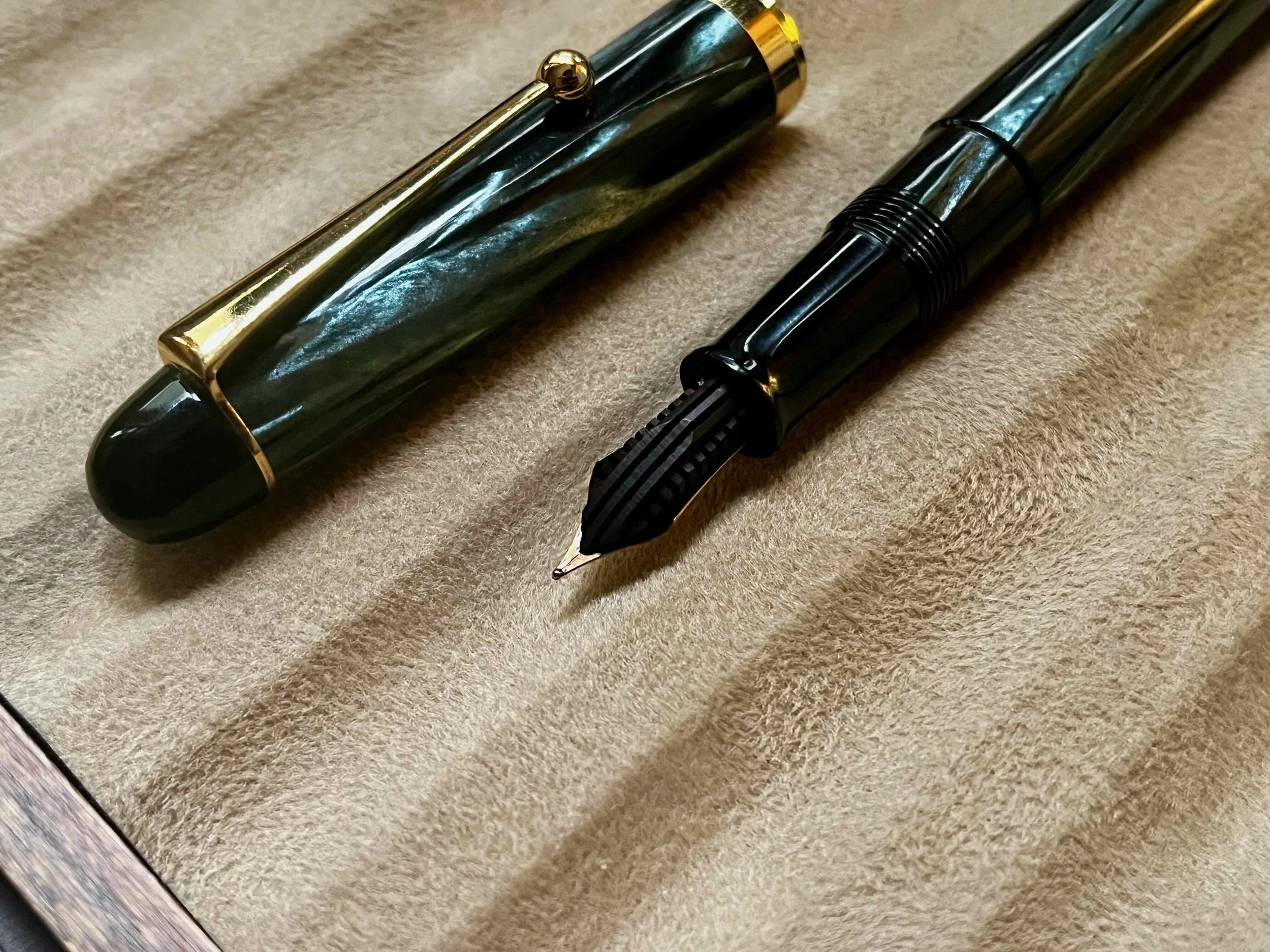
The ebonite feed on a model 2000
Post-Spaceman, Kato pens carry no external markings. The signature traits are the celluloid, the nib engravings, and a clip that either resembles the Pilot-style ball clip or a Pelikan-style upsweep clip. These help in identifying Kato’s pieces, given how nondescript the pens otherwise are. The 800F in blue can pass for a Parker Duofold at a glance. Some variations of the 2000, if I’m being honest, can pass for a pen that gets handed out to attendees at a three-day conference. I don’t mean that as an insult. Not in the slightest. If anything, it encapsulates Kato as a person, craftsman, and industrialist: his pens don’t announce themselves. He didn’t either. I imagine that many people who own a Kato pen don’t know they own one.
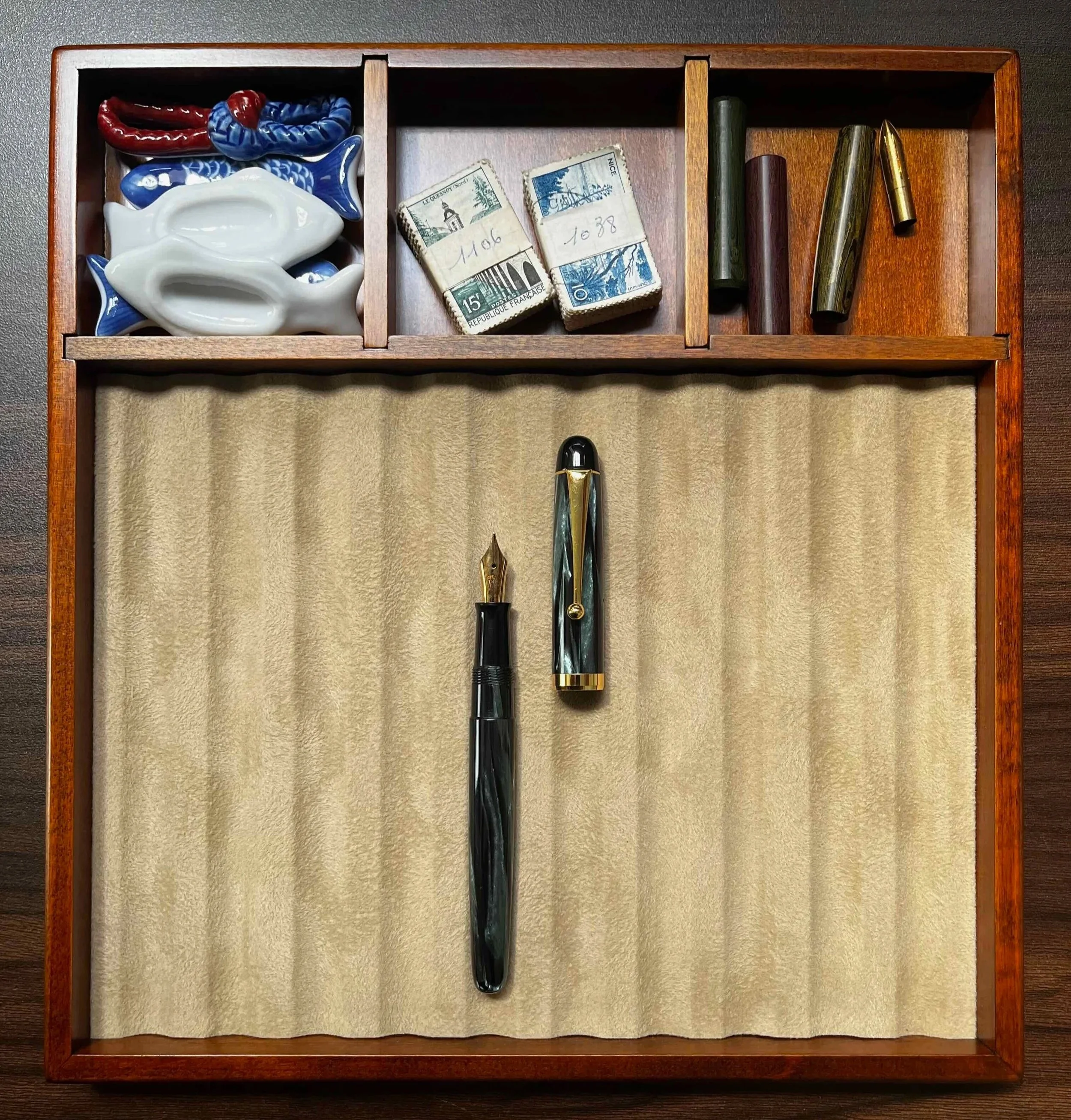
Kato Seisakusho’s model 2000
Kato passed away in 2010.
It took a while for me to find a Kato fountain pen. Most of what came up on auction was in acceptable but rough condition, and I kept losing on principle, refusing to break my internal price ceiling. When a 2000 finally appeared, in better shape than anything I had bid on at higher prices, no one else bid. I won it for cheap. Holding the model 2000 in my hand, I feel the weight of Kato’s life and legacy. Ironically, the physical weight of the pen itself is light at only 9 grams uncapped. Kato stuck with nitrocellulose to the end. The price for that loyalty shows up in the survivors: gold plating worn off the trims, barrels and caps shrinking and warping. The legacy he left is indelible, but its physical manifestations are fragile.
Kiyoshi Kato started his career digging up his backyard. He ended it having ascended heights few ever will. He’s a Spaceman.
Category III.
糸田さんへ
—Kato Seisakusho 2000, Sailor Blue Black
Notes / Sources
Parts of the background in this piece draw on catalog archives and collector accounts, including:
http://itoda.server-shared.com/katou.html
https://akashiclife.wordpress.com/2017/07/23/万年筆名匠絕演-morison-antique-pen-no-083-prototype/
https://www.kabanya.net/post_533/
https://pensible.wordpress.com/tag/kato-seisakusho/
https://taiwantpe.blog.jp/archives/cat_382166.html?p=5
https://alkalicell.wordpress.com/2017/10/22/katoseisakusho-2000series/
-
September 2026
- Sep 28, 2026 The Montblanc in the Attic
- Sep 24, 2026 Pelikan M800
- Sep 10, 2026 Hotel Stationery: Tokyo Station Hotel
-
August 2026
- Aug 29, 2026 Sakura Craft Lab 001
- Aug 17, 2026 1969 Sailor Mini 21
-
July 2026
- Jul 20, 2026 The Pen Case I Have in Mind
- Jul 8, 2026 Kyoei’s Kiwami Writing Mat
-
June 2026
- Jun 22, 2026 In Defense of the Converter
- Jun 12, 2026 Sailor King Profit
- Jun 5, 2026 Komeda’s Coffee in Bali
-
May 2026
- May 16, 2026 Japanese Ateliers (III): Kato Seisakusho
-
April 2026
- Apr 26, 2026 Pelikan 400NN
- Apr 12, 2026 On Ebonite Feeds
-
March 2026
- Mar 26, 2026 After the Ink Is Gone
- Mar 22, 2026 Hotel Stationery: The Langham Hong Kong
- Mar 19, 2026 Hotel Stationery: The Aman Tokyo
-
February 2026
- Feb 22, 2026 Japanese Ateliers (II): Hakase
- Feb 14, 2026 Japanese Ateliers (I): Nakaya
- Feb 7, 2026 The Price of Writing in Gold
-
January 2026
- Jan 31, 2026 The True Heir
- Jan 24, 2026 Lifestyle