
Lifestyle
Status has long been associated with certain fountain pen brands. Montblanc is the obvious example. In more recent years, newer and smaller brands have followed the same logic, often with greater subtlety. Traveler’s Company, a division of Midori, has built a remarkably loyal following around a single product: the Traveler’s Notebook.
At its core, the system is simple. A leather cover with interchangeable inserts. These range from plain notebooks and watercolor paper to weekly planners. One practical reason for the brand’s success is size. The covers are produced in two proprietary formats: the “regular” size (slightly smaller than A4) and the “passport” size (slightly smaller than A6). Midori produces the inserts, and very few third parties match the dimensions accurately. As a result, the ecosystem remains largely captive. Of course, proprietary sizing alone does not create a cult following.
The more important element is the lifestyle the brand suggests. Traveler’s Notebook is presented not merely as stationery, but as a companion; something meant to accumulate evidence of one’s life. The user is encouraged to decorate and archive the trivial objects that would otherwise disappear; a receipt from a ramen shop in Hakodate, a quick sketch made at a table in Odawara, a sticker from a convention abroad. Over time, the notebook becomes a container for memory, and—if the habit continues—an evolving narrative object. So long as we keep purchasing the proprietary refills, that is.
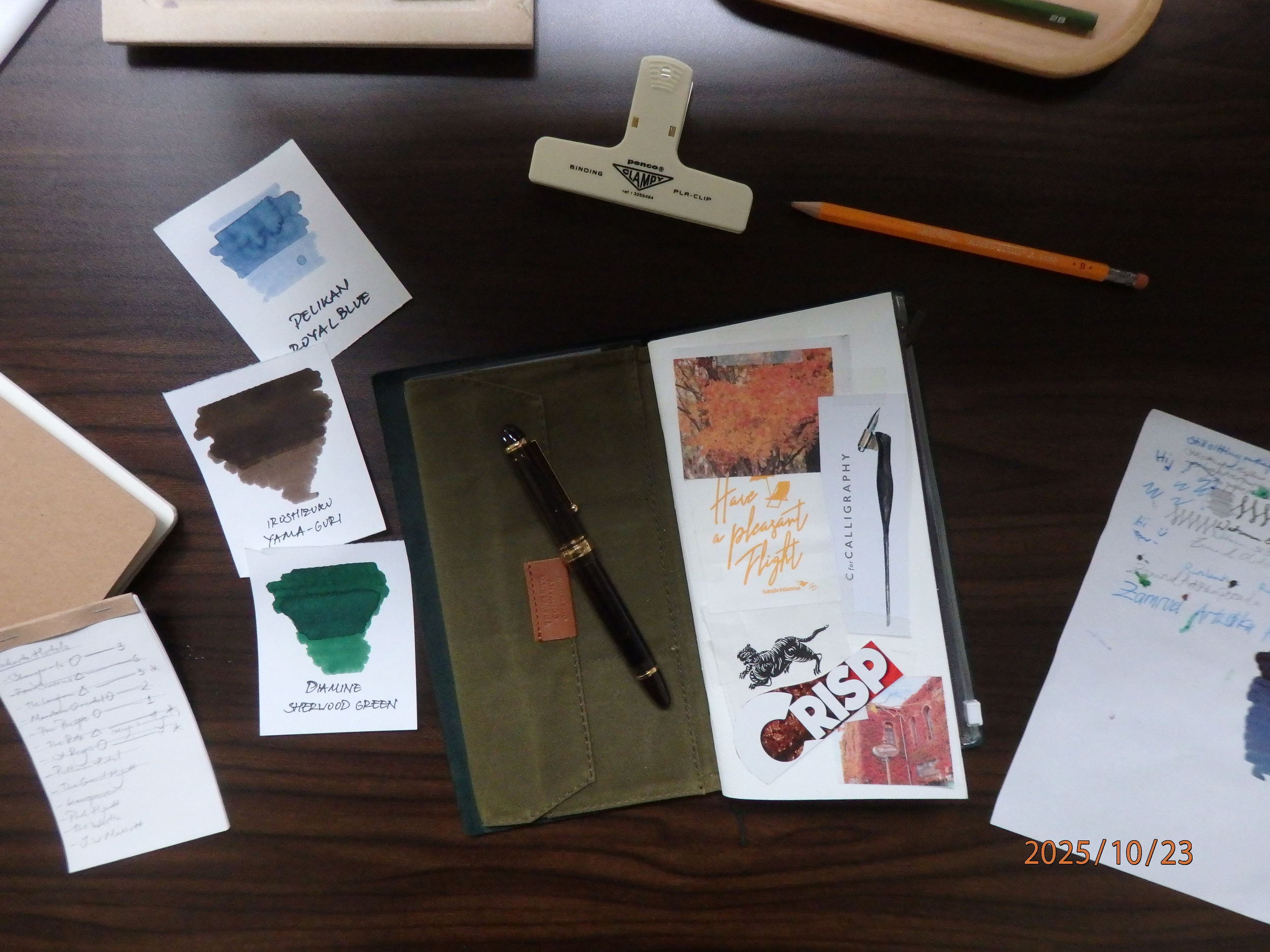
A regular size traveler’s notebook.
I am not ashamed to admit that I like the product. I am fully aware of the consumerist machinery behind it, and I still participate. Design Phil has done its work well, and the result is effective.
Among the accessories is a small brass pocket fountain pen. It is fitted with a Schmidt #5 nib, and “TRAVELER’S COMPANY MADE IN JAPAN” is discreetly engraved on the cap. Brass, of course, is chosen for what it does with time—it takes patina, like leather. It “ages,” and therefore fits the brand’s narrative of use, travel, and accumulation.
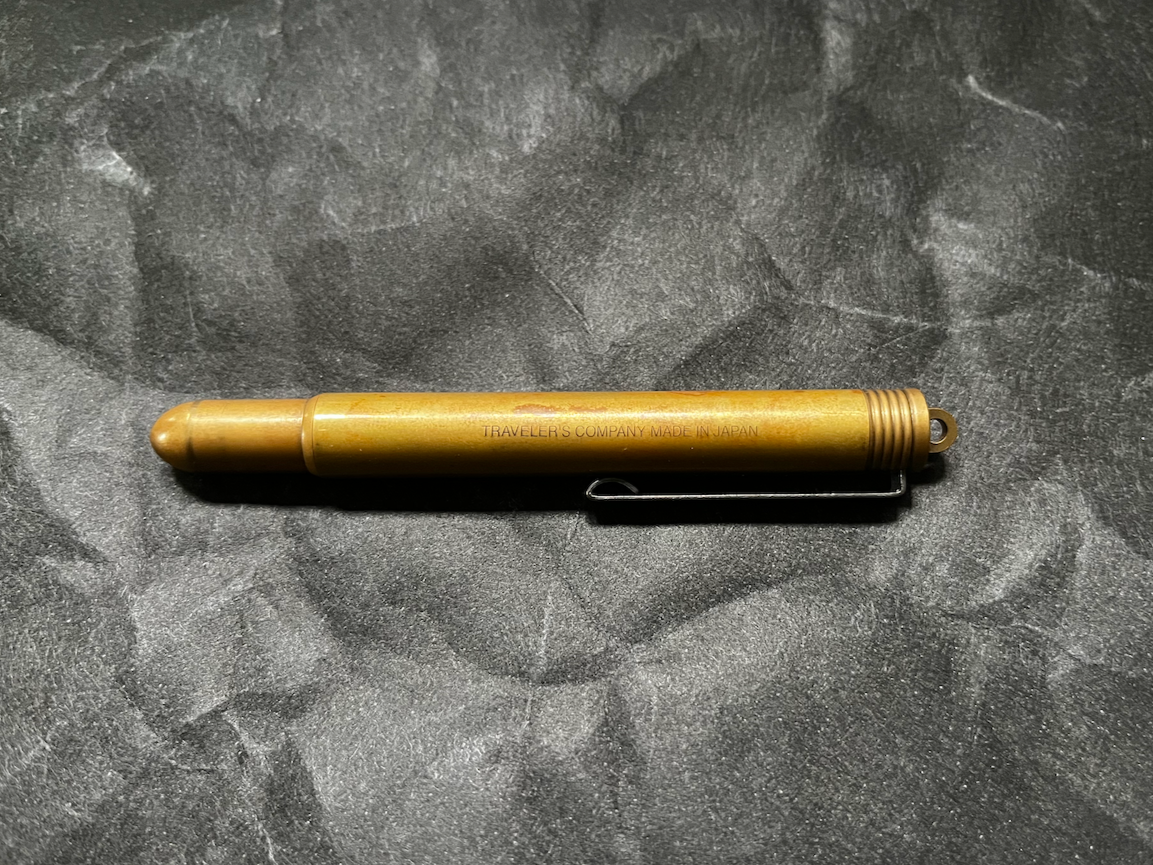
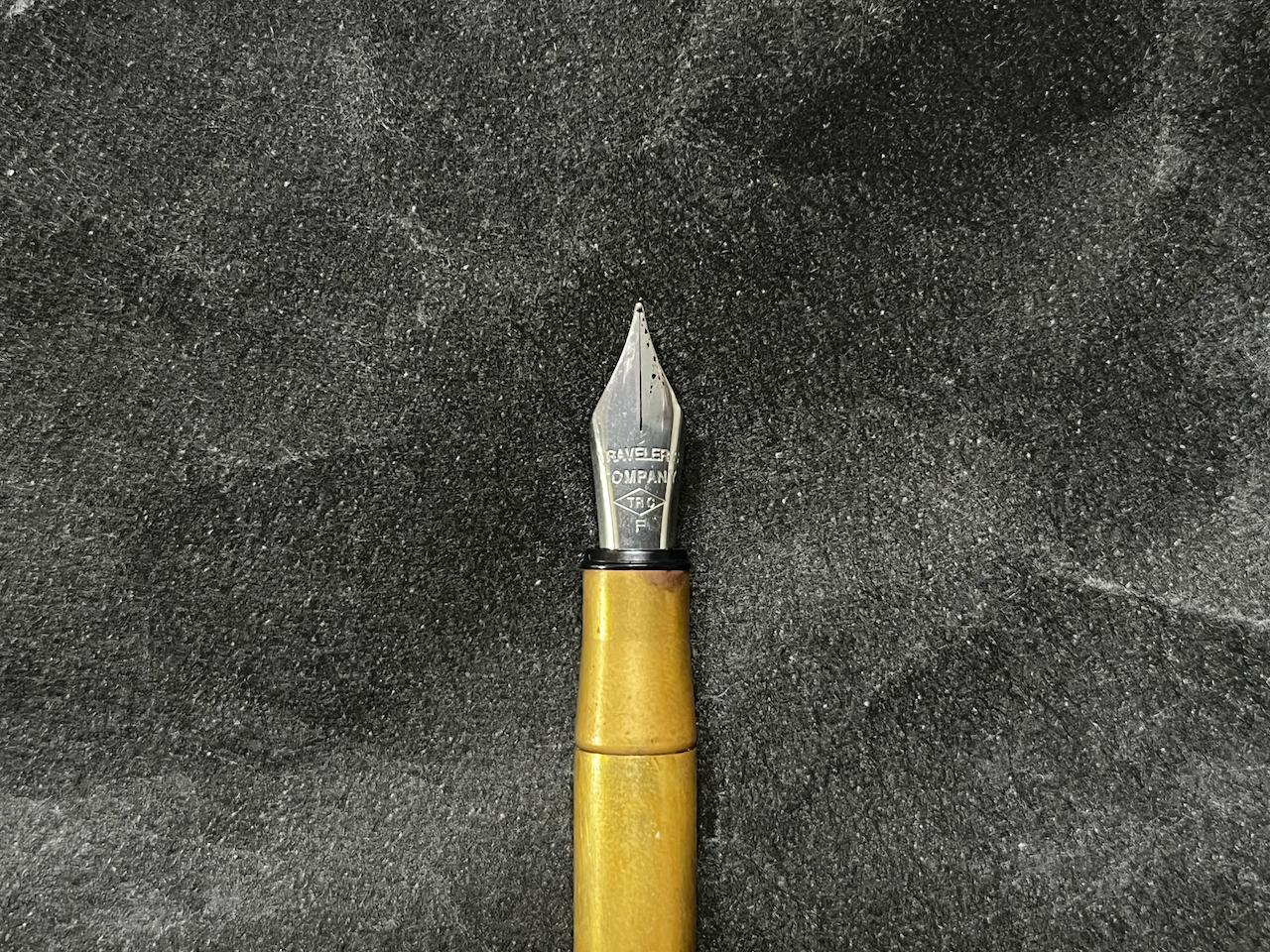
The #5 schmidt nib on the traveler’s brass fountain pen. It only comes in a fine nib.
The pen is only offered with a fine nib. That would normally be a disadvantage for me, as I have gradually preferred wetter and broader nibs. Yet it remains in my rotation despite the presence of objectively better writers. There is a quiet charm to the small bullet-shaped brass body. The material provides a sense of durability; it is one of the few pens I can post without thinking about scratches, and as a pocket pen it ends up balanced in a way that some larger instruments are not. In practice, it is the pen I still choose for travel, even though I own others with higher ink capacity, softer nibs, and more refined writing feel.
It is certainly not due to my affinity for what Traveler’s Company represents. My thanks to Atsuhiko Iijima, for making it so easy to pretend otherwise.
—Traveler’s Brass, Kaweco Caramel Brown
-
September 2026
- Sep 28, 2026 The Montblanc in the Attic
- Sep 24, 2026 Pelikan M800
- Sep 10, 2026 Hotel Stationery: Tokyo Station Hotel
-
August 2026
- Aug 29, 2026 Sakura Craft Lab 001
- Aug 17, 2026 1969 Sailor Mini 21
-
July 2026
- Jul 20, 2026 The Pen Case I Have in Mind
- Jul 8, 2026 Kyoei’s Kiwami Writing Mat
-
June 2026
- Jun 22, 2026 In Defense of the Converter
- Jun 12, 2026 Sailor King Profit
- Jun 5, 2026 Komeda’s Coffee in Bali
-
May 2026
- May 16, 2026 Japanese Ateliers (III): Kato Seisakusho
-
April 2026
- Apr 26, 2026 Pelikan 400NN
- Apr 12, 2026 On Ebonite Feeds
-
March 2026
- Mar 26, 2026 After the Ink Is Gone
- Mar 22, 2026 Hotel Stationery: The Langham Hong Kong
- Mar 19, 2026 Hotel Stationery: The Aman Tokyo
-
February 2026
- Feb 22, 2026 Japanese Ateliers (II): Hakase
- Feb 14, 2026 Japanese Ateliers (I): Nakaya
- Feb 7, 2026 The Price of Writing in Gold
-
January 2026
- Jan 31, 2026 The True Heir
- Jan 24, 2026 Lifestyle