
Japanese Ateliers (II): Hakase
There are three types of fountain pen makers.
Those a casual user will inevitably encounter: Sailor, Pilot, Platinum, etc. (I).
Those that only an enthusiast with time spent in the hobby would discover (II).
Finally, those that require an enthusiast to go off the beaten track (III).
This series will cover makers in categories II and III. The niche within the niche. The donut hole within a donut’s hole.
Hakase (Category III)
Many enthusiasts have heard of Namiki and Nakaya. Far fewer have of Hakase. Hakase is a workshop based in Tottori. A city that sits along Japan’s western coastline, Tottori itself is known for its sand dunes and camel-riding.
Hakase is known for its custom fountain pens made of exotic materials—water buffalo horn, ivory, among others. Many collectors associate Hakase with green celluloid, however (more on this later). Prices begin at 100,000円.
Hakase (万年筆博士) had roots in Tokyo as a fountain pen manufacturer in the 1920s. After a brief stint in Dalian, China, and later Osaka, founder Yoshio Yamamoto ultimately settled in his hometown of Tottori. At this point, Hakase had switched from manufacturing to selling fountain pens from other manufacturers. Its tools, however, would survive and later establish the foundation of the workshop today. In the 1980s, CEO Masaaki Yamamoto saw the writing on the wall: fountain pens were a tool of the past. If Hakase was to survive, it had to be more than a stationery store. With craftsman Harumi Tanaka, Hakase’s bespoke fountain pens were born.
Today, Hakase is led by Ryo Yamamoto, the third-generation owner. Before committing to Hakase, Yamamoto raced motorcycles, and at one point, sold medical equipment. There’s irony in the latter; in English, 万年筆博士 literally translates to: Dr. Fountain Pens [Hakase (博士) = Doctor; Mannenhitsu (万年筆) = Fountain Pens].
According to an article by ONESTORY, Yamamoto produces 120 pens per year all by himself. By his own account, Yamamoto had to learn the craft solely through observation. And even then, he still had to face the fact that Hakase’s seventy-year old tools needed replacing. Since such specialist equipment is no longer manufactured, he sought out recreating them. The work has taken a toll. He lives with tendonitis and goes to acupuncture twice a week to keep it in check. He has trained other craftsmen before, but none have stayed.
With such limited output, wait times stretch from 27 to 31 months as of February 2026. Very rarely does a Hakase appear on the secondary market. After all, Hakase is an even smaller operation than Nakaya. There are unique qualities to Hakase’s pens that make them difficult to part with as a user/collector. Specifically, Hakase’s sporting Pilot OEM nibs and those made of celluloid.
Distinctive readers may have had a double take on that last sentence. Pilot doesn’t do OEM. Yet, for Hakase, they do. As far as I know, Hakase is the only entity in the world with which they have such an agreement with; complete with Hakase’s own engraving on the nibs. Other makers who use Pilot nibs have to make do with buying Pilot pens and using them as donors—a completely different relationship—one we’ll get to when we discuss another small maker.
Then there’s the use of nitrocellulose for Hakase’s celluloid pens.
Nitrocellulose is the product of a bygone era. At the time, injection-molded plastics had not yet been developed; hard rubber (ebonite) and casein were the common materials. Nitrocellulose was revolutionary in a way that it allowed brilliant colours and marble patterns never seen before on industrial products. However, nitrocellulose is flammable, making processing difficult and even dangerous by modern standards. For this reason, the use of nitrocellulose is heavily regulated.
There’s also the case of “celluloid rot”. Celluloid rot is a phenomenon where celluloid starts to degrade and off-gas, producing a camphor and/or vinegar smell that accelerates the degradation of other celluloid pieces in its vicinity. The timeframe for celluloid rot is uncertain. Numerous Sheaffer Balances from the 1920s (made of nitrocellulose) still survive today, while others have long decomposed, leaving a brittle mess.
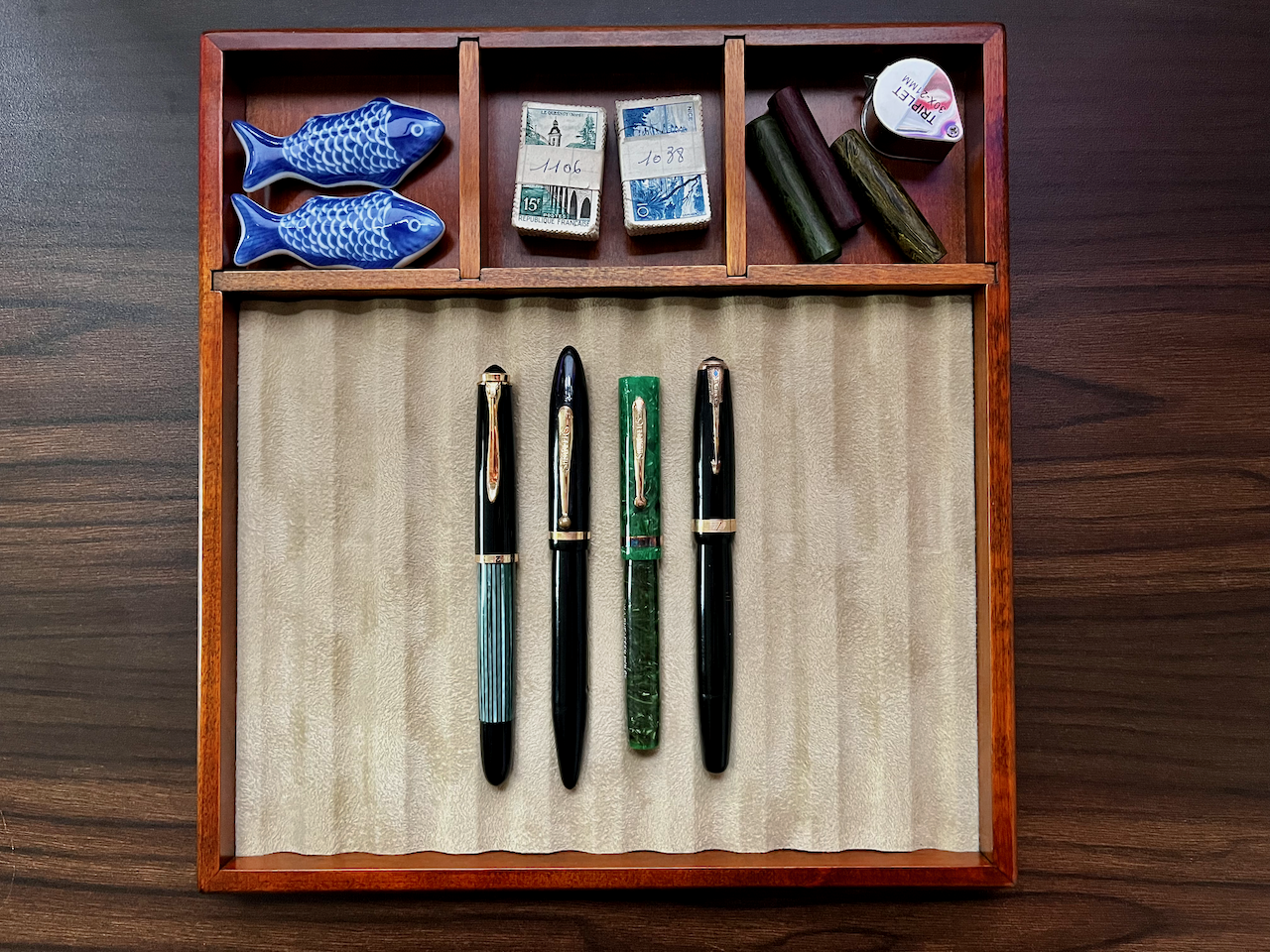
A collection of 50+ year-old celluloid fountain pens free of celluloid rot (so far). Left to Right: Pelikan 400NN, Sheaffer Balance 5-30, Sheaffer Flat Top Junior, Parker Vacumatic
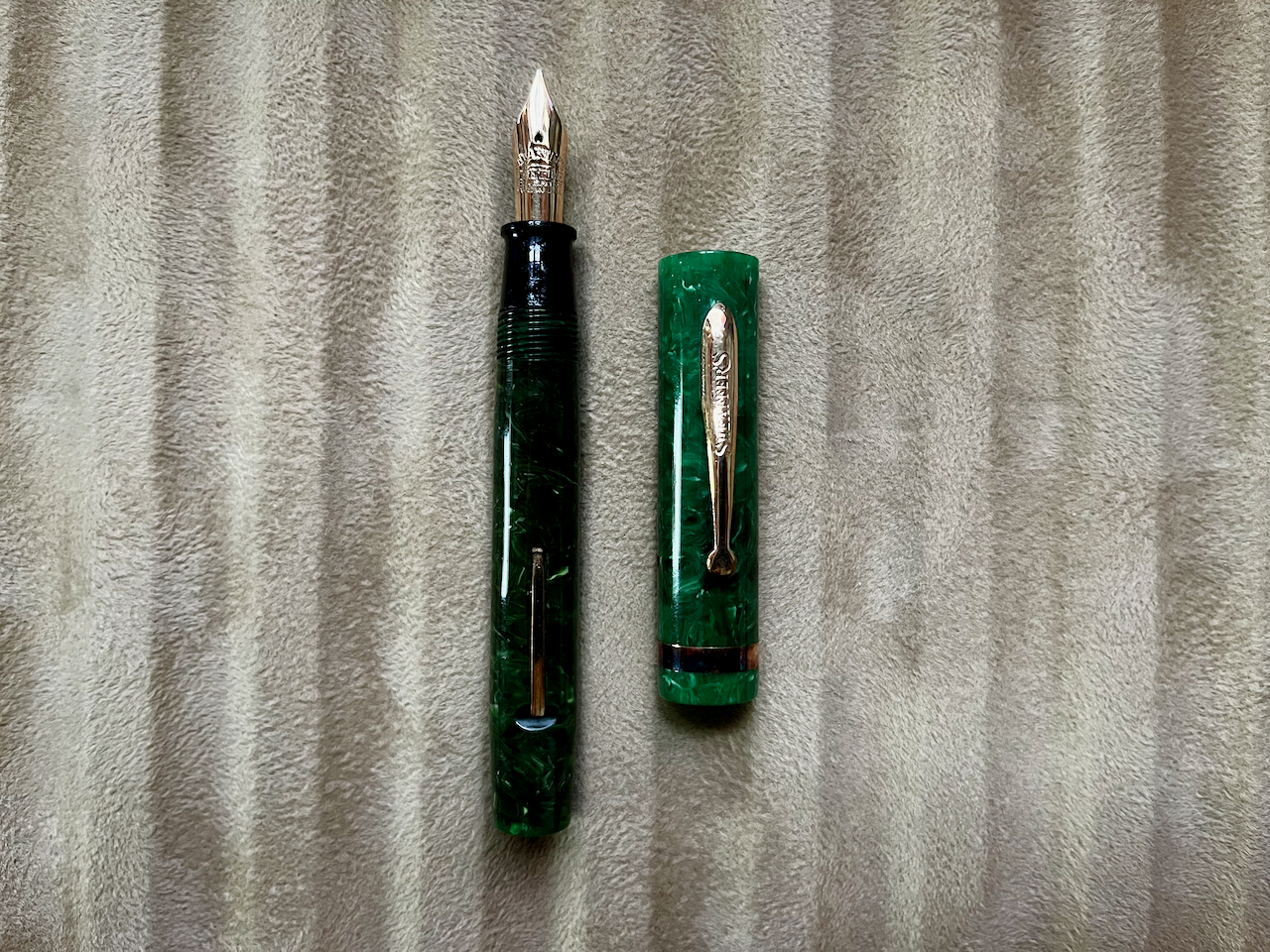
Note the Sheaffer’s darkened barrel in contrast to the cap. Decades of exposure to the internal rubber sac has caused discoloration—another flaw of celluloid.
For those reasons, modern “celluloid” pens are typically made of cellulose acetate—a modern formulation that does not have these troublesome qualities. It turns out non-flammable is a very popular feature in manufacturing.
Yamamoto’s use of nitrocellulose, then, can be seen as an act of rebellion, conservatism, or even romanticism. Using a material that’s inherently temperamental certainly tells a story for both Hakase and the user. It carries with it a particular kind of weight: the skill of the craftsman, the exotic material, the fleeting nature. There’s no other maker quite like Hakase. Nor should there be; this individuality found in Japanese makers is precisely what makes them so collectable and desirable.
Hakase does not have any retail partners. A visit to their workshop in Tottori is required to handle a Hakase pen. A visit allows Yamamoto to directly observe your writing habits—letting him adjust the dimensions and feel for each user upon ordering. Nib wetness, feedback, barrel length, barrel girth—each user prefers a slightly different balance—all variables for Yamamoto to manipulate. Alternatively, an order can be placed through Hakase’s website, though I suspect the first option is preferred. Filling out the writing-habits form requires a certain self-awareness from the individual that’s hard to balance. My writing changes the moment I start assessing it.
As if it’s not enough for Yamamoto that Hakase offers one of a kind bespoke fountain pens, they also offer true sepia ink. “Sepia” today more often than not refers to a brown-amber colour. Hakase’s definition means the word in its truest sense: sepia ink extracted from cuttlefish. Yamamoto had spent a decade of research revitalizing this formula that traces back to the times of Plato and Aristotle to be suitable for fountain pens. According to Hakase’s website, twenty bottles are made per month.
I corresponded with Yamamoto about logistics. I asked if it’s possible for him to hold the pen until I can pick it up in his workshop. I wanted to make the trip to Tottori to receive it properly and pay respects, but it’s difficult to plan a trip 27 to 31 months in advance. He just said, politely, that the pen would be completed in that timeframe, and that I should plan accordingly.
It’s hard to tell which part is most implausible: the years-long queue, the nitrocellulose, the true sepia ink, or the fact that one of the world’s largest companies made room for him. Category III.
—Parker Vacumatic, Pelikan Royal Blue
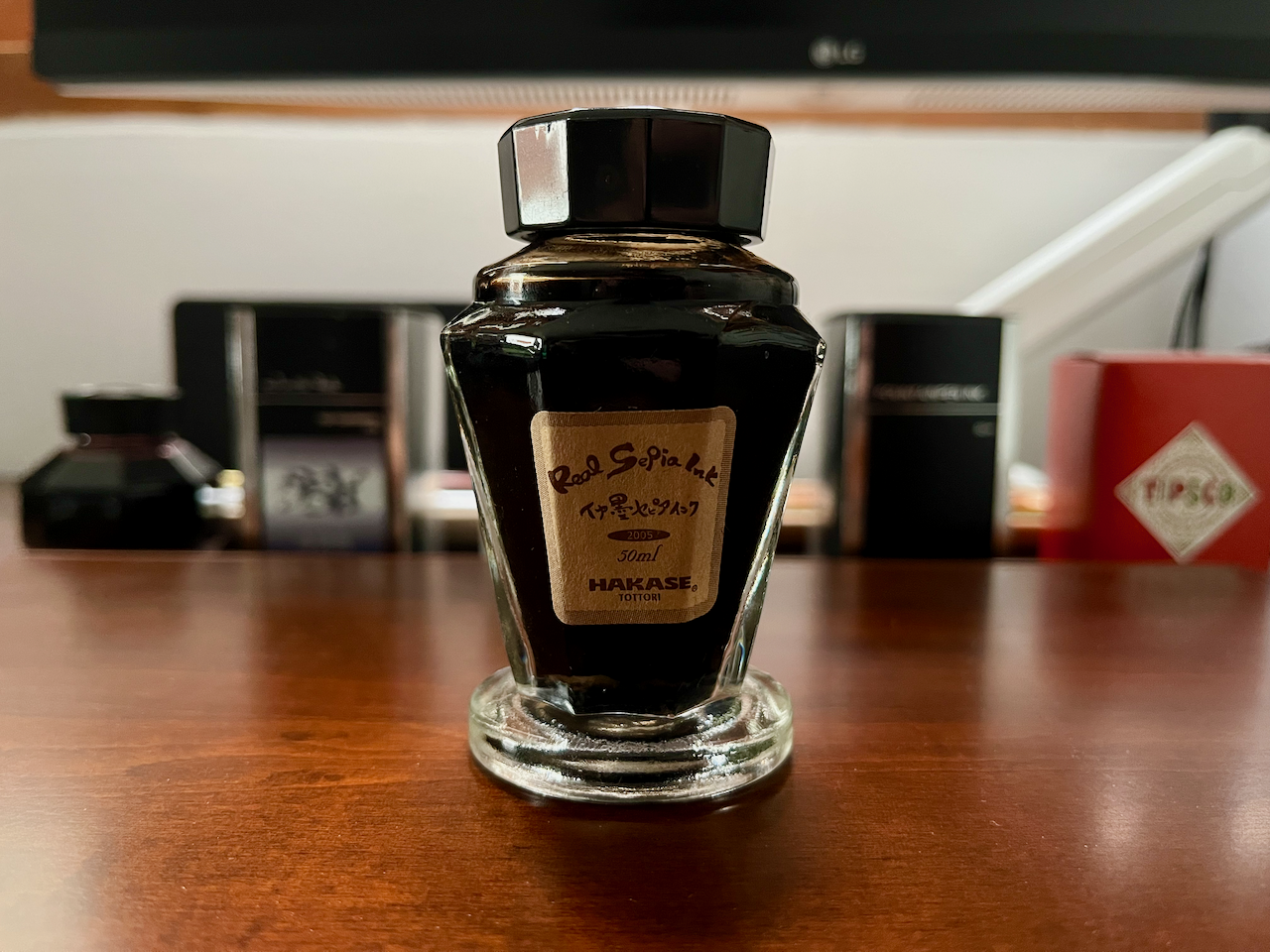
Hakase’s True Sepia Ink (dark variant)
Notes / Sources:
Parts of the background in this post are based on a couple of ONESTORY articles about Hakase: https://www.onestory-media.jp/post/?id=2808; https://www.onestory-media.jp/post/?id=2809
-
September 2026
- Sep 28, 2026 The Montblanc in the Attic
- Sep 24, 2026 Pelikan M800
- Sep 10, 2026 Hotel Stationery: Tokyo Station Hotel
-
August 2026
- Aug 29, 2026 Sakura Craft Lab 001
- Aug 17, 2026 1969 Sailor Mini 21
-
July 2026
- Jul 20, 2026 The Pen Case I Have in Mind
- Jul 8, 2026 Kyoei’s Kiwami Writing Mat
-
June 2026
- Jun 22, 2026 In Defense of the Converter
- Jun 12, 2026 Sailor King Profit
- Jun 5, 2026 Komeda’s Coffee in Bali
-
May 2026
- May 16, 2026 Japanese Ateliers (III): Kato Seisakusho
-
April 2026
- Apr 26, 2026 Pelikan 400NN
- Apr 12, 2026 On Ebonite Feeds
-
March 2026
- Mar 26, 2026 After the Ink Is Gone
- Mar 22, 2026 Hotel Stationery: The Langham Hong Kong
- Mar 19, 2026 Hotel Stationery: The Aman Tokyo
-
February 2026
- Feb 22, 2026 Japanese Ateliers (II): Hakase
- Feb 14, 2026 Japanese Ateliers (I): Nakaya
- Feb 7, 2026 The Price of Writing in Gold
-
January 2026
- Jan 31, 2026 The True Heir
- Jan 24, 2026 Lifestyle