
Pelikan 400NN
The easiest way to feed a hobby is to buy more. Fountain pens are no exception. A new pen, a new ink, a limited release before it disappears—the justifications come readily, and the hobby itself encourages them. To experience more, you acquire more. It is a logic that is hard to argue with. The Pelikan 400NN taught me there is another way. Ironically, it did so by being a purchase.
The 400NN belongs to Pelikan’s postwar series. It was produced in Germany between 1956 and 1965, and to my mind, it represents Pelikan at its best. The monotone 14C nib is soft, the use of plastic piston seals requires less maintenance than cork, the striped celluloid has generally held up beautifully, and despite its small size holds 2 ml’s of ink. The 400NN is also, I suspect, the beginning of Japan's love affair with Pelikan; the M800's popularity in Japan did not come from nowhere. The Japanese affection runs deep enough that a “Japan version” was eventually produced in the 400NN Merz & Krell. For more on that, Joshua Danley is, as usual, the place to start.
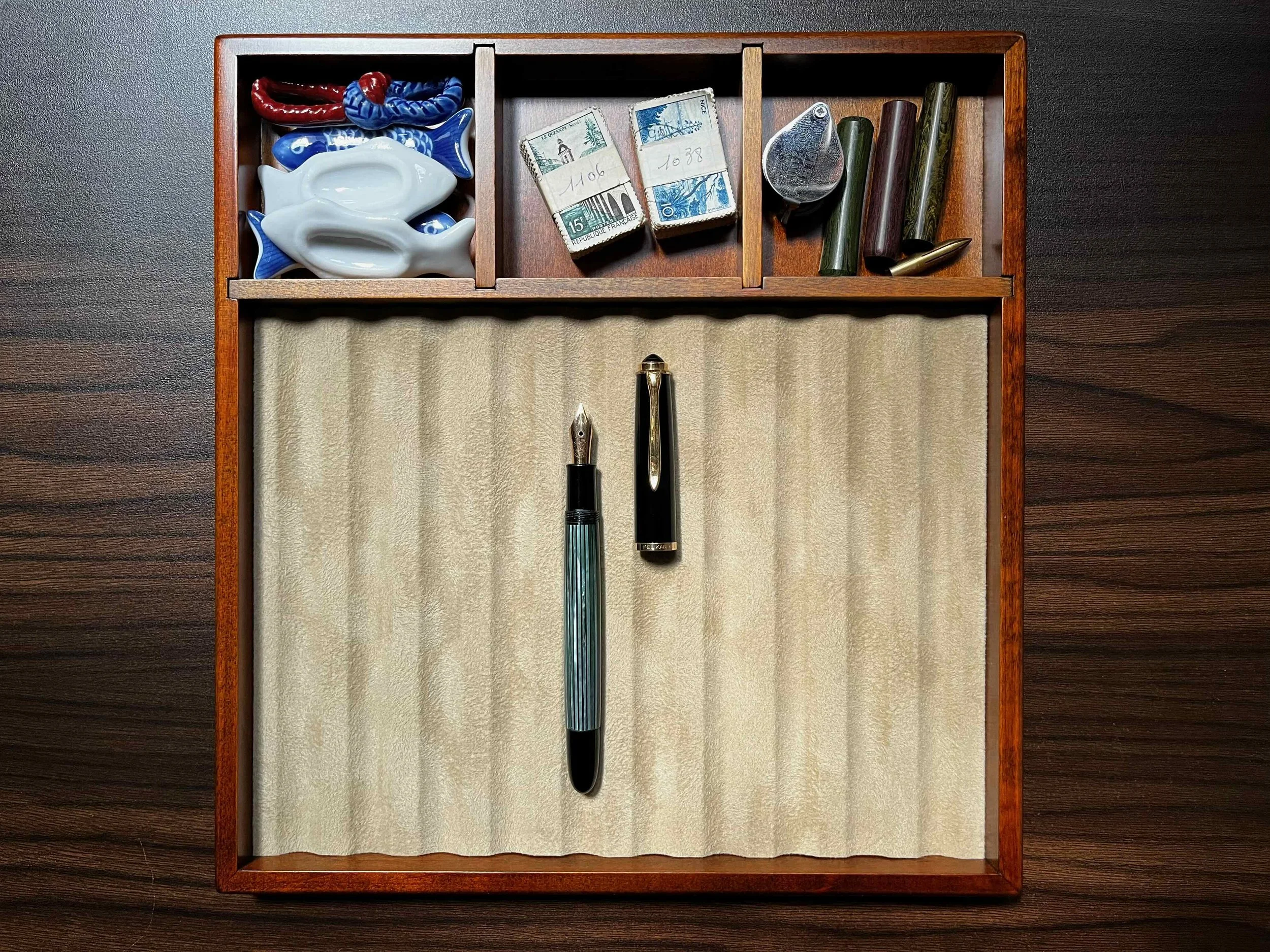
The Pelikan 400NN (1956-1965); the Merz & Krell version was later introduced in 1973.
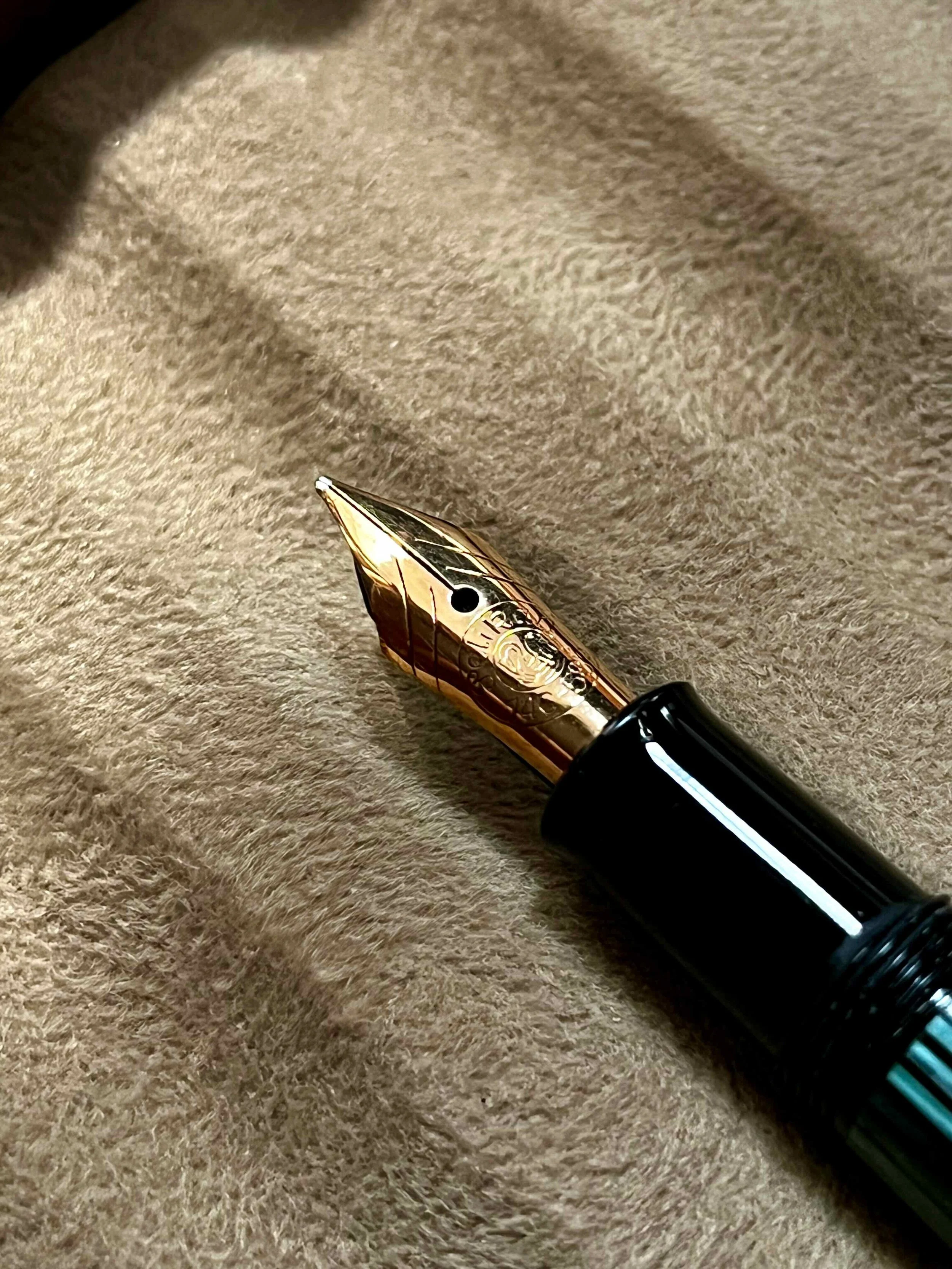
The 400NN’s 14C nib
I wrote about this pen once before in a piece about ebonite feeds. It appeared then as a cautionary example. That account was accurate, but incomplete.
Readers of the ebonite piece may come away with the impression that I despise this pen. It is quite the contrary. The 400NN's troubles led me somewhere I otherwise wouldn't have gone. Because of my struggles with the nib unit, I learned how indispensable ultrasonic cleaners are in pen restoration. In doing so, I stumbled upon Danley's blog, and being the treasure trove of information that it is, I ended up realising that two ordinary-looking Pelikans I had acquired cheaply were, in fact, rare and desirable. When I had lost faith in my ability to fix the pen myself, I found my way to Kawakubo-san of 川窪万年筆 (Kawakubo Fountain Pen), a nibmeister and repairman whom I had the pleasure to visit, and ended up admiring.
There is a version of this hobby that is purely consumptive. I have lived that version. The 400NN pulled me toward something different—toward Danley's blog, toward people such as Kawakubo-san whom I would not otherwise have met. In a way, くらしの文具 (Kurashi no Bungu) was found because of the 400NN; without it, I would never have discovered my enjoyment of reading about fountain pens, and would never have had the desire to contribute. The joy, for me, turned out to be in that direction.
The feed of my 400NN is still brown. At first, I wanted that undone. Now I do not.
—Pelikan 400NN, Rohrer & Klingner Alt-Goldgrün
-
September 2026
- Sep 28, 2026 The Montblanc in the Attic
- Sep 24, 2026 Pelikan M800
- Sep 10, 2026 Hotel Stationery: Tokyo Station Hotel
-
August 2026
- Aug 29, 2026 Sakura Craft Lab 001
- Aug 17, 2026 1969 Sailor Mini 21
-
July 2026
- Jul 20, 2026 The Pen Case I Have in Mind
- Jul 8, 2026 Kyoei’s Kiwami Writing Mat
-
June 2026
- Jun 22, 2026 In Defense of the Converter
- Jun 12, 2026 Sailor King Profit
- Jun 5, 2026 Komeda’s Coffee in Bali
-
May 2026
- May 16, 2026 Japanese Ateliers (III): Kato Seisakusho
-
April 2026
- Apr 26, 2026 Pelikan 400NN
- Apr 12, 2026 On Ebonite Feeds
-
March 2026
- Mar 26, 2026 After the Ink Is Gone
- Mar 22, 2026 Hotel Stationery: The Langham Hong Kong
- Mar 19, 2026 Hotel Stationery: The Aman Tokyo
-
February 2026
- Feb 22, 2026 Japanese Ateliers (II): Hakase
- Feb 14, 2026 Japanese Ateliers (I): Nakaya
- Feb 7, 2026 The Price of Writing in Gold
-
January 2026
- Jan 31, 2026 The True Heir
- Jan 24, 2026 Lifestyle