
On Ebonite Feeds
Romanticism keeps many hobbies alive long after practicality has left the room.
Vintage cars are a good example. They overheat, leak, require attention, and occasionally behave as though they resent being driven at all. Yet people continue to love them, and unreliability stops being treated as a flaw and starts being described as soul.
Fountain pens have their own versions of this in ebonite feeds.
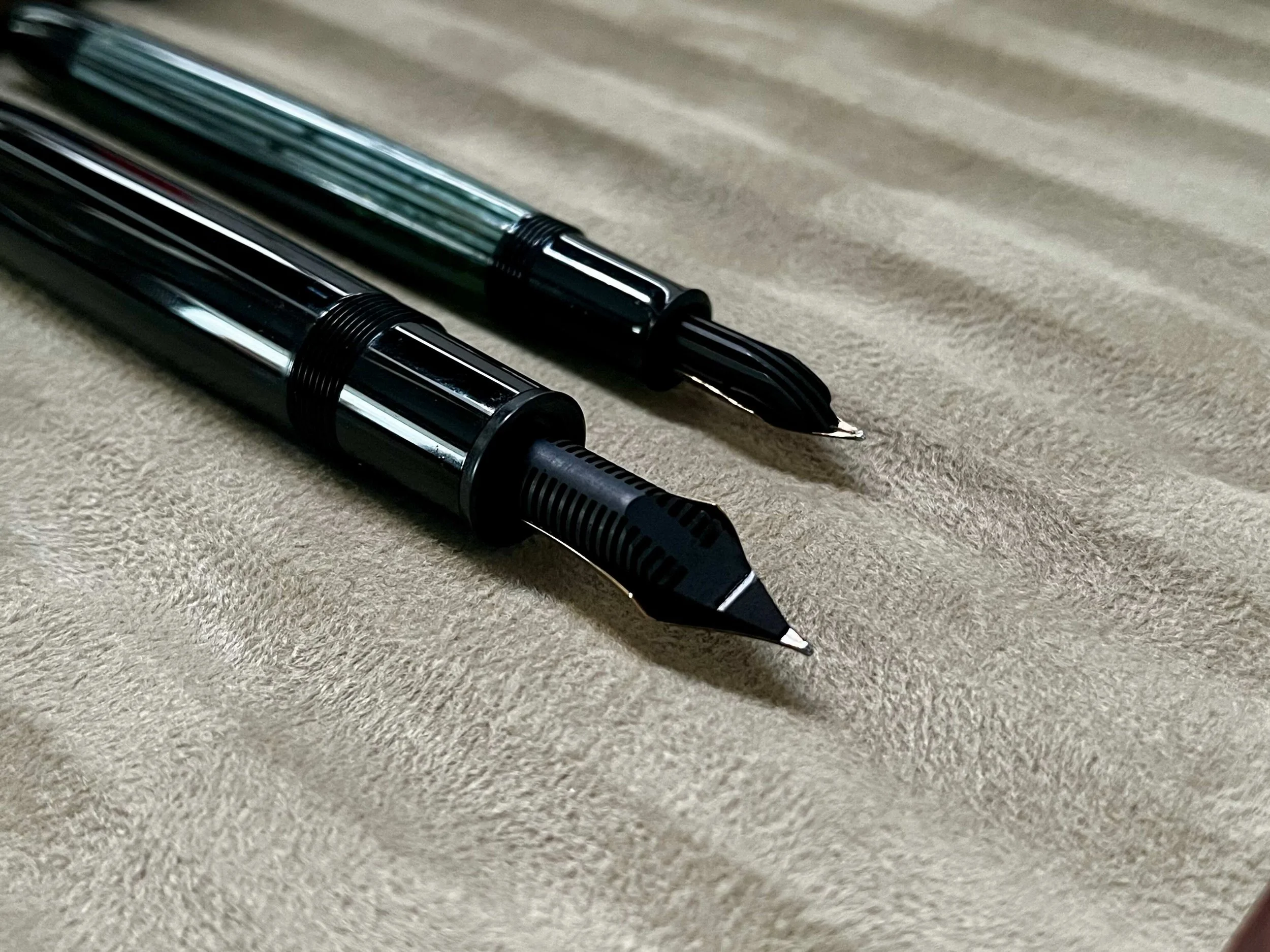
A couple of ebonite feeds—Montblanc’s (bottom) and Pelikan’s (top).
Among enthusiasts, especially those with a weakness for vintage pens, ebonite enjoys a reputation. Mention that a pen has an ebonite feed and half the work of persuading the buyer has already been done. Makers know this, too. It is the sort of feature that gets announced with extra emphasis.
The case for ebonite is not imaginary. It is porous, which helps with capillary action, and it can be heat-set, allowing the feed to be adjusted so that it sits more closely against the nib. In the hands of someone who knows what they are doing, this can make a real difference. There are even people fitting vintage nibs into modern pens with the help of ebonite feeds, precisely because the material allows a degree of manipulation that plastic does not.
Enthusiasts, however, have a bad habit of taking a real advantage and promoting it into a complete philosophy. Ebonite may help with ink flow, but it does not guarantee it. Ink flow is not a morality play between noble porous rubber and soulless injection-moulded plastic. It is a matter of design, tolerances, fit, and execution. A well-designed plastic feed will write better than a badly tuned ebonite one every day of the week. This is the part that tends to get lost.
The other side of ebonite is less glamorous. It is brittle. It oxidises. It tolerates less stupidity, and unfortunately stupidity is often what maintenance looks like in real time. A pen does not announce, in advance, which twist of the fingers is one turn too many. A feed fin does not send a polite warning before it shears off. Anyone who has spent time looking at vintage Montblancs or Pelikans will have seen it already: chipped fins, collapsed sections of feed, damage that most likely came not from catastrophe but from ordinary clumsiness.
Then there is oxidation. Leave ebonite in water too long and the deep black turns brown. The pen may still function perfectly well, but that is not really the point. You have altered it, you have taken a part that survived for decades looking one way and, through an act as innocent as soaking, made it look older. This became more than theoretical for me when a Pelikan 400NN entered my life. It had an ebonite feed, and the pen would not write. The piston worked. Ink was in the barrel. Nothing happened. So naturally I tried to inspect the nib unit more closely.
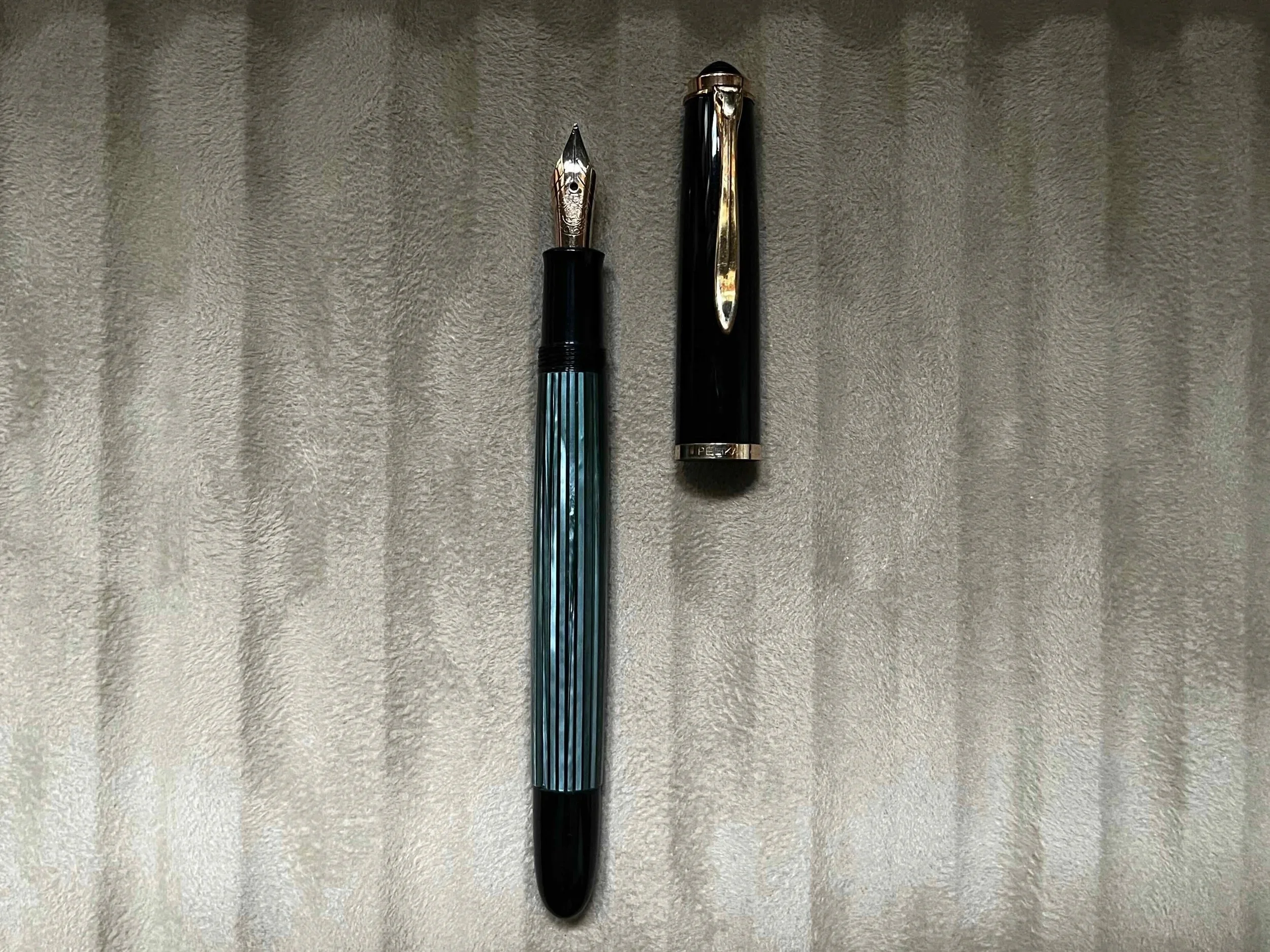
Pelikan’s 400NN (1956-65)
What I remember most clearly is not the resistance itself, but the feeling that accompanied it. The amount of torque required to unscrew the unit was enough to make me stop. Not because it was impossible, but because it felt like one more turn might snap the feed in half. Anyone who has handled old materials will know the sensation. There is a point at which the object ceases to feel stubborn and starts to feel endangered. So I did the sensible thing and soaked it, hoping to loosen whatever had seized. By the time I came back, the feed had turned brown.
The nib unit still did not unscrew, and the pen still did not write. I had acquired a second problem, cosmetic this time, layered on top of the first. My once-pristine 400NN now had an oxidised feed, and I was no closer to understanding why the ink flow had failed. Eventually the pen had to be disassembled with proper tools by a professional. My suspicion had been correct all along: the issue could not be solved without taking the nib unit apart. But that is almost beside the point. The point is that I did not do it myself. For the first time, an ink flow problem crossed the line from manageable nuisance into something I felt unequipped to deal with.
The advantages of ebonite feeds are real, but so are their demands. They reward competence, punish hesitation harshly, and tolerate overconfidence even less. This is fine if you enjoy that sort of relationship with your pen. Many people do. But it is worth being honest about what exactly is being admired.
Because there are very good reasons manufacturers moved to plastic feeds, and not all of them begin and end with cost. Plastic is easier to manufacture, yes, but it is also stable, consistent, and more forgiving. It can be engineered to write wet and reliably without asking the user to treat maintenance like bomb disposal. Pilot’s Custom 823 and Custom Urushi are hardly starved for ink. Modern Pelikans with plastic feeds are plenty generous, often more so than vintage pens whose ebonite feeds are spoken of with reverence.
This is where the romance starts to show itself most clearly. If a modern plastic feed can deliver equal or better performance, then the appeal of ebonite cannot be purely functional. Part of what is being valued is the sense that the older material is closer to craft, closer to tradition, closer to some lost standard of seriousness. Sometimes that may even be true.
But sometimes it is just hobbyists flattering themselves for preferring the more temperamental option.
I do not mean that as an insult. Romanticism is part of what makes hobbies enjoyable in the first place. Very few of us are here because we have selected the most efficient writing instrument available. Fountain pens are already an unreasonable choice. To insist, within that unreasonable choice, that the more fragile and maintenance-sensitive component is inherently better feels less like engineering and more like the familiar logic of enthusiasts everywhere: it is troublesome, therefore it must be superior.
Sometimes it is, but sometimes it is just troublesome.
—Pelikan 400NN, Rohrer & Klingner Alt-Goldgrün
-
September 2026
- Sep 28, 2026 The Montblanc in the Attic
- Sep 24, 2026 Pelikan M800
- Sep 10, 2026 Hotel Stationery: Tokyo Station Hotel
-
August 2026
- Aug 29, 2026 Sakura Craft Lab 001
- Aug 17, 2026 1969 Sailor Mini 21
-
July 2026
- Jul 20, 2026 The Pen Case I Have in Mind
- Jul 8, 2026 Kyoei’s Kiwami Writing Mat
-
June 2026
- Jun 22, 2026 In Defense of the Converter
- Jun 12, 2026 Sailor King Profit
- Jun 5, 2026 Komeda’s Coffee in Bali
-
May 2026
- May 16, 2026 Japanese Ateliers (III): Kato Seisakusho
-
April 2026
- Apr 26, 2026 Pelikan 400NN
- Apr 12, 2026 On Ebonite Feeds
-
March 2026
- Mar 26, 2026 After the Ink Is Gone
- Mar 22, 2026 Hotel Stationery: The Langham Hong Kong
- Mar 19, 2026 Hotel Stationery: The Aman Tokyo
-
February 2026
- Feb 22, 2026 Japanese Ateliers (II): Hakase
- Feb 14, 2026 Japanese Ateliers (I): Nakaya
- Feb 7, 2026 The Price of Writing in Gold
-
January 2026
- Jan 31, 2026 The True Heir
- Jan 24, 2026 Lifestyle